answer

Stress has stolen my sleep, or at least its quality, in recent days. I am incessantly exhausted, running solely on a combination of adrenaline and sugar, as my sleep has been interrupted, disturbed, upset. Stress is a clever thief, often lurking quietly in the shadows until just the moment when I attempt to rest, until just the moment when I am seeking the solace of slumber, the peace and healing offered in sleep. Those are the moments when my stress furtively tiptoes into the forefront of my mind and my brain begins to work harder, ideas and worries and concerns flood in, my heart rate picks up and my eyes open…staring at the ceiling. I don’t want to give in and get up; however, the longer I lay there, the more the stress intensifies. Until I suddenly realize that since I’ve been up worried for so long, I’ll never get enough sleep and then my stress is compounded.

Despite the seeming routine of these events, I never see it coming. Instead, it is just all of a sudden present, and once that occurs, reason and relaxation are out of mind and the swiftness of their eventuality is called into question.

Regular exercise was my greatest outlet for relieving this kind of stress and for deepening my sleep. But since last November when my inner ear decided to throw its own kind of wild party, regular exercise has become more of an intermittent affair. I am just not feeling well enough regularly enough to make a habit of it–to be able to maintain the discipline. That is a true frustration point because I honestly enjoy working out–I honestly enjoy pushing myself and my body to the outer limits of my fitness ability and my body has essentially told me, “Um, no thank you. That time is done.” I am trying to convince myself that walking is a viable fitness plan until more healing has taken place and I am ready to do more. But this all or nothing mentality that I am apt to adopt sees that remedy as circumspect. I don’t  want to just have to walk–I want to be able to do push ups and box jumps and to lift weights. I don’t want to be restricted anymore. I want to be well. I want to be and feel like myself…my best self.

And in that frustration, guilt is born. I know I should just be grateful for being mostly well and not be greedy about what workout I am relegated to. Honestly, I should be grateful for a great many things.

And that has become my newest remedy for stress–I turn in toward my gratitude. When I focus on what I am thankful for, I make a conscious turn away from stress. As I focus on the positivity specific to my life with intentionality, my brain slows down and my heart rate calms. My breathing is more methodical and my gratitude list suddenly becomes a prayer of sorts lulling me into a calm and escorting me toward peaceful sleep.

It doesn’t work every time, this gratitude journey of mine. Sometimes, I just have to work through the stress without avoidance. Sometimes, I have to face it. But sometimes, most often, I can extend myself the grace of recentering my thinking.  And when I am able to do so, I am a better human…and not just because of better sleep, but also because learning to see the world through the lens of a grateful heart is a mind shift that heals and offers hope. And hope, when we work to find it, not only changes our hearts for the better, but also our actions. Where there is hope and gratitude, stress cannot reside.

(Day 19 of this king cake season writing challenge…I for real almost quit tonight after starting three different blogs and getting nowhere with them. Nothing to show for them other than some unfinished saved ramblings. And I was so exhausted and had so many other things to do…but I just felt compelled to prove this one to myself…that I wouldn’t give into the temptation of quitting…that I would honor myself and remain dedicated)
transformative

High school students enter my school everyday with their own individual sets of “stuff.” It would be naive to demand or command that they adhere to some delusional set of unreal expectations that implies that perfection is the only allowable outcome–constant, never wavering hard work, attentiveness, dedication, positivity, even-keel temperament, and a zeal for the subject matter. These kids, though, are teenagers and their most important job in the moment really doesn’t have anything to do with getting into college or taking on leadership roles in clubs or pleasing me. Their most important job has everything to do with figuring out who they’re going to be in this world, what kind of person they will become. If I narrow-mindedly assume that my class should always be their first priority, I have lost sight of the fact that these students are living complete and complex lives. If I can’t extend a little grace toward them, with the understanding that they will have good days and bad because in fact they are human beings, then I’ve missed the point.

In her poem “Kindness,” Naomi Shihab Nye writes these words:

“Before you learn the tender gravity of kindness,

you must travel where the Indian in a white poncho

lies dead by the side of the road.

You must see how this could be you,

how he too was someone

who journeyed through the night with plans

and the simple breath that kept him alive.”

She is writing about empathy’s integral role in kindness. She is writing about the sort of transformative moment that empathy creates as it brings  sincerity and  weight to common niceties. Nye seems to imply that in order for kindness to live into its potential, for it to truly be meaningful, we must see ourselves in the situations of others. We must recognize the common ground of humanity in everyone we encounter. We must see our sameness in order to be able to nurture each other through our differences. We must understand that someone else’s misfortune could be our own.

In that awareness, we not only become truly kind, but we also transform ourselves into better human beings. We are able to creep out of our shell of selfishness in search of ways to help those in need around us…even the people we don’t necessarily know because we have paused to imagine life through their eyes. We are able to shift out of our own biases to see the truth of the people around us rather than our assumptions about them…assumptions that imprison and inhibit our true kindness potential.

This is what I attempt to achieve in my classroom. I work really hard to see beyond the moment and to understand what is causing the moment. Is the student tired, overwhelmed, going through a hard time…what is the reason for the behavior? In doing this, I’m working to pause before rushing to judgement. I am working to give them the benefit of the doubt.

I was recently reminded by my friend Sara Ahmed of the benefit of the “soft start” in classrooms. This is a brief period of time at the start of a class where students are actively engaged in an activity that interests them but isn’t necessarily course work.  So, this week, I have placed magazines, adult coloring books, books of poetry, QR codes for a Padlet full of links to interesting articles, writing prompts and more on the tables of my classroom. The kids come in, sit down anywhere they are comfortable and work on whichever activity they feel best suits them that day. Part of why I offered this, outside of the fact that it is just good practice, I was sort of struck by the realization that our kids go from class to class with sometimes stark contrast in subject matter and we expect them to immediately switch gears without much pause. The soft start allows kids to decompress a bit and to transition so that when it comes time to work on coursework, they are better prepared and mentally ready to focus. My students this week have said that at first they thought the “soft start” was silly and a little fluffy. After a couple of days though they realized that it was really helping them–they felt like they were thinking better in class because they had that moment to quiet themselves and find their focus. I loved this!! However, if I stood harshly by the idea of working bell to bell, if I ignored the needs of my students, we would have missed out on this transformative.

It was a kindness. I saw myself in the way we ask them to “do school” and understood that there could be a better way. I recognize that there are people out there who think that because of my level of empathy, I am too soft on my kids. There are people who feel like I am not preparing them for the real world. On the contrary, I feel like I am preparing them to become leaders in the world I want to live in. A world filled with sincere kindnesses. An empathic world.

(Day 18)

struggle

I am struggling to find my focus tonight and so I’m afraid you will be subjected to my random ramblings (Feel free to abandon me here). Long days at work that translate into writing that doesn’t start until 9:30 are marked by a brain that is moving at a snail’s pace. It’s difficult to sift through the day in search of the moment that should be extracted and elaborated upon and shared. It’s difficult to push past that voice in my brain that is yelling (loudly) “For the love of all that is good in this world, woman, go to sleep!” And tonight is harder than most. But, I’m still here. I’m still honoring the discipline by putting words on the page. I will still get to a point where I click “Publish” even though I do not feel as though a single word of this piece, a piece that is essentially just me treading water, should be published. But I’ve made a commitment to write everyday and I intend to see that through. Regardless of where this goes, even if there is only one more sentence to be written, I made the time, I found the energy, I did the work. I never said that I would publish good writing everyday, only that I would in fact write. I never realized the kind of perseverance this endeavor would require of me…it really just sounded like a fun proposition at the outset…it sounded manageable. And I guess to some degree it has been, but these school nights have made things tougher than I anticipated.

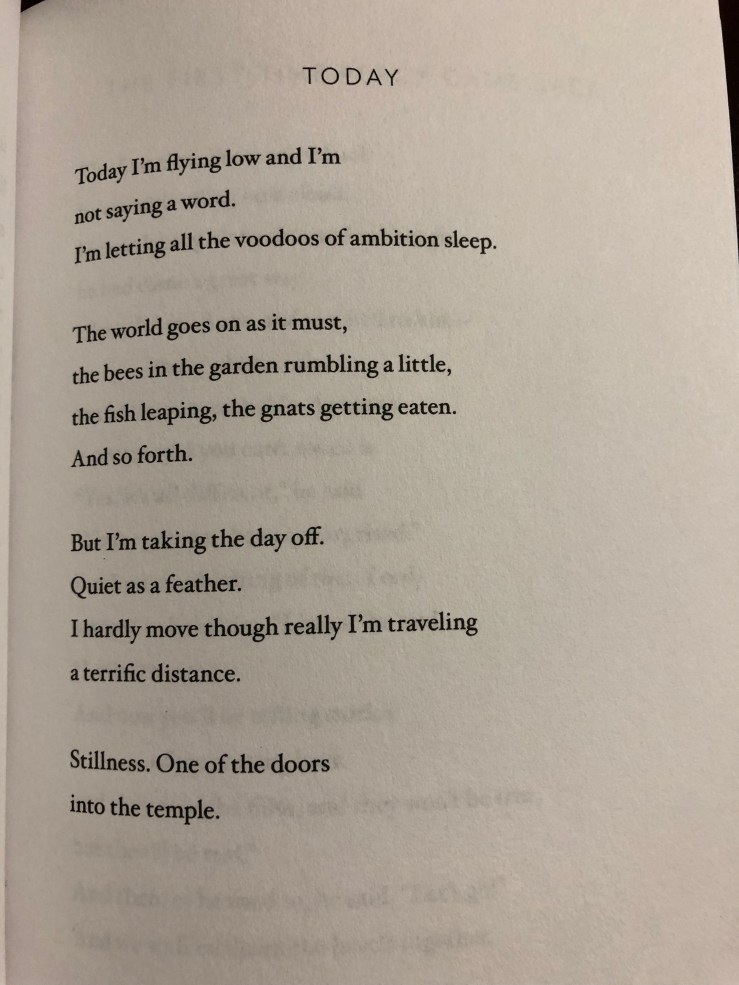
So rather than belabor that point, I’m going to be done for tonight. It feels a little bit like cheating and I’ve made a list of ideas for tomorrow so that installment will not suffer as this one has. And I will leave you with one of my favorite Mary Oliver poems ever…the stillness that I seek is spoken of here. Always grateful for her words, her simplicity and her wisdom. As my words fail, enjoy hers.

(Day 17 — I’m counting it)

IMG_1863.jpeg

ask

So, I’ve spent the weekend with teachers from around the country talking about and considering the importance of inquiry and literacy for kids. Even though we have all come from different places, it just so happens that this institute is being held in my home town, New Orleans. However, despite being in my actual hometown, I have found myself confronted and surrounded by more thoughtless stereotypes about this city that I love and about what it could mean to be from here than at any other point in my life–which has also heightened my realization that the number of people who buy into these over generalizations and the number of people who label the residents of this city based on those assumptions is far larger than I might have originally thought.

I suppose I sort of insulate myself–wrap myself in the belief that surely people know there is something more to the fabric of this richly historic town, something more to its culture and to the people who cling to it fervently than just raucous drunkenness. More than just a Southern drawl (that actually doesn’t even exist here). More than the sort of grotesque caricature shown in film and on television that is fun to imagine but denies the complexity of reality.

I just assumed that people would know better. I felt like if nothing else, the resilience and spirit the people of this city displayed in the aftermath of Katrina should have helped to erase some of the broad brush strokes. People weren’t just clinging to a city in those days; they were clinging to their home. But time has passed and I suppose those images have become blurry, maybe a little forgotten.

So, as I attempt to absorb and understand the nature of these predispositions, as I attempt to inform without sounding too defensive, I recognize that as frustrating as this bias has been, I don’t have to face it everyday. On any given day, I am mostly surrounded by native Louisianians. But, there are far too many people in this world who have been walled in by stereotypical expectations and who live every single day of their lives trying to break free from that prison of sorts. I have come to realize that just as teachers at this institute  have been breaking away from their assumptions by working through an inquiry process, through a question asking process to uncover some truths about this city and its people, we need to be conducting inquiry every single day of the week in every week of every year to uncover the truth of those around us. We need to take the time to ask the questions that will scratch past the facade we have created with our simplistic assumptions.  We need to ask questions that show interest in actually understanding rather than gathering ammunition to further judgement. We need to ask questions so that we can listen and consider the information and then reconsider our original thoughts. We need to ask questions without fear of having to admit we were wrong–because that admission is where the change begins.

I’ve lived in or near this city my whole life and felt like I didn’t really need this inquiry group study. Except in asking questions on our topic, I realized there was still more to uncover. I was reminded that my story and understanding of this city is just one of many and that I haven’t paid nearly enough attention to some of the threads that make the fabric of this town so rich, so vibrant. In acting as though we know the truth of a person or community or faith or country without ever asking or seeking to know more, without ever hearing the narrative of the person or people living the reality, we will live our lives ignorant of the vibrance of the whole story. And that loss is profound. That loss is dangerous.

Ask.

(Day 15 of the king cake season writing challenge–this could have easily been about the Saints playoff game instead…figured I would channel that energy here instead…can’t win them all I suppose…)


inquiry

This weekend, I’m attending a Heinemann Professional Learning Institute in New Orleans on Curiosity across the Curriculum with teachers from across the country and I’m totally geeking out over the opportunity to sit and wonder and have my thinking pushed to the far reaches. I think that is something that so many of us as teachers–wait, what am I talking about…this is universal…I will rephrase–I think that is something that so many of us as humans are afraid of these days. We cocoon ourselves in the thinking that feels comfortable and safe in order to shield and protect ourselves from ideas and questions that might challenge what we are currently doing, feeling, or believing. I think this is part of what has led to the deterioration of discourse. It is, after all, easier to hide from or to yell over new ideas rather than to listen and consider them.

This institute is not only putting adults of varying backgrounds and viewpoints in a room together and asking them to question, consider and wonder, but the presenters are asking the teachers in attendance to help our students do the same thing. To allow students entry into their own education. To grant students permission to hear not just the teacher’s opinions on what is most important to know and how to learn it, but also permission to voice their own opinions and wonderings about the world…to invite students to be heard and to be seen in this moment as they are for who they are. If we preach acceptance of others to our kids, then we have to start living into that and that means accepting the kids in front of us too.

Instead of denying their thinking (and its validity/quality) and their curiosity because it doesn’t fit the curriculum, let’s start listening with ears that build bridges between their thinking and that mandated curriculum instead of with ears that only hear the disconnect. The concern that the curriculum offers no place, no time for wonder and for student driven inquiry is a valid one because often times it does not. So, we have to be creative and push ourselves to think beyond what has been handed to us in order to see further possibilities. We need to consider how much deeper the learning will be when the kids have taken ownership of it and are invested in a very real way. Make that concern your next wonder, your next curiosity and let it drive your next personal inquiry. If we are the lead learners in the room, we also have to be the lead wonderers. So, dig in, ask the questions, tell your kids about them and then figure out a means to experiment and play around with how to enact this in your classroom. And by all means don’t be afraid to push the boundaries of what you have always done. That is, after all, what we ask kids to do every single day that they enter our space to learn!

At some point today, I realized that I hear all of this as a mom as well. It is so easy to get caught up in the day to day actions and jobs of taking the boys to school, carting them to activities, ensuring homework and studying are completed, feeding everyone, and so on that I lose sight sometimes of asking them what is on their minds…and then also really listening when they share that with me. It is easy to get caught up in the need to clean rooms and to be on time and to ask the questions that I want to know the answers to that I forget to find out what questions are brewing in their brains. And I am certain there must be a zillion of them. It is so easy for me to pontificate on what to do in the classroom with other people’s kids when it comes to wonder and curiosity but when I consider if I have actually enacted that in my own home, well, I’m pretty guilty of not always being able to find the time. So, there’s that…

As I sit and listen this weekend…as I sit and enact an inquiry project, I am not only thinking about how this applies in my classroom but also in the world at large and in my home with my own family. Always important to remember that out of the cocoon, the caterpillar becomes a butterfly. Hoping to break out of my cocoon of comfort this weekend and spread my newfound wings as I reach for new understanding and begin to live it out.

(Day 14…this might be more of a rant than anything, but it just kind of flowed naturally so I let it happen instead of stopping to craft and edit along the way…a fun change. Many thanks to Sara Ahmed, Smokey Daniels, Steph Harvey, Nancy Steineke, and Kristin Ziemke for pushing my thinking this weekend! You guys are amazing!!)

vision

I bought my first pair of reading glasses today and while that feels strange to admit (because in my head, I am still like 32) it also feels a bit like a rite of passage. A normal aging thing after all the weird illnesses and meannesses my body has inflicted on me. Honestly, I was a little excited by the normalcy of it. Finally, something that everyone for the most part will deal with eventually!! I wasn’t desperately in need of these glasses. I only really need to wear them when my contacts are in and even then I can get by. I mean, I am able make out the words on my screen or on the page…just not as easily as I once could. So I procrastinated…longer than I should have. I grew comfortable in my discomfort because it was easier than taking the steps of solving the problem.

It was sort of like when I was sick because of my inner ear, my car got out of hand messy. I mean unbelievably so. I was embarrassed just sitting in the car by myself let alone if anyone else had to see it. But I was sick and didn’t have the energy or the desire to fix the problem, to clean it out. So, I ignored the mountain of water bottles and magazines and books and more and just harbored by discomfort because even though it made me sort of miserable it was easier to drive the false facade around than solving the problem, easier than taking the time to clean up the mess inside.

When my ear was a bit of a disaster, I knew there was a surgery that could fix it but it terrified me, so I did everything else instead. I tried every treatment available except the one that would be nearly guaranteed to work. Chiropractic, Acupuncture, Essential Oils, Physical Therapy, TMJ Treatments, and more. All desperate measures to avoid the one definite fix. Why would I procrastinate when help was available? Who knows, really? I could tell you it was because of the cost of the surgery or that it was so close to my brain that it scared me, but the truth is that neither of those is the real answer. I was somehow simply resigned to being miserable and blinded myself to the solution.

I think we do this all the time in various ways. We table our issues, our anxieties, our concerns and just learn to live with them, rather than really dealing with them, rather than taking the steps to actually cope with them. We are willing to accept the false feelings of ease rather than work to uncover what might be a thorny path to healing, recovery, rest or health. Forgetting all the while that though the thorns may sting and intensify the misery in the short term, they are also necessary points along the way to healing…to a clearer path…to the river of rebirth that allows us to cleanse ourselves of whatever ails us.

When I put those glasses on my face and I looked down at my phone screen today to see if they really helped, I was entirely astonished at the clarity and precision of the words on the screen. I had not realized just how blurry things had gotten until a new lens, a new perspective allowed me to see the truth of the matter. And I sat there for a minute just wondering what on earth took me so long and how many more times will I fall prey to the laziness of accepting unnecessary discomfort…

“Autobiography in Five Short Chapters” by Portia Nelson

(Day 13–exhausted from a very long week, but still found a moment to knock this one out. Not my most careful writing, but happy to have it done).

impact

Ask any student who has set foot in my classroom and they will tell you “Mrs. Clark is super passionate about words…words matter after all.” And they would be right, I am sort of constantly in awe of what we as humans are able to do simply in the arrangement and selection of the words we wield. We can brandish them dangerously, carelessly damaging others with rancor and vitriol. Or, we can employ them meaningfully, intentionally provoking thought with depth and weight.

One of the reasons poetry resonates with me the way that it does is that I find myself in constant wonder of the poet’s word craft–of their ability to be so precise in their execution of word economy, while at the same time creating gorgeous imagery or intensity or moments to pause and wonder or heightened emotion or all of these and more. It is the surprise in the organization that gets me, the arrangement I would never have considered that drops my jaw. I love the form that creates the content as much as the content itself.

~~~“Breakage” by Mary Oliver~~~

I say all of this because Mary Oliver died today. Mary Oliver was a poet that I believe, honestly, could reach anyone as she wrote honestly and simply yet somehow in her simple language led readers into the complexity of human emotion and experience. She didn’t require fancy forms or intricate language; she didn’t write beyond her experience, no matter how simple the moments may have been; she didn’t reach for what wasn’t true to her and in maintaining that sincerity, her readers were able to find their true selves in her work.

~~~ From “The Journey” by Mary Oliver~~~

“…

But little by little,

as you left their voices behind,

the stars began to burn

through the sheets of clouds,

and there was a new voice

which you slowly recognize as your own,

that kept you company

as you strode deeper and deeper

into the world,

determined to do

the only thing you could do–

determined to save

the only life you could save.”

In the natural world Mary Oliver sought solace and God and understanding of life and its proverbial mysteriousness and through the natural world she brought the rest of us solace and God and an understanding of life. She opened my eyes to not just the beauty in the world around me but to its nuance and to a new way of paying attention to it. Her words, her insight, her description all still my soul.

~~~“Fall” by Mary Oliver~~~

(the last stanza here is just perfection and will alter your perception of rain forever)

And then there are the Mary Oliver poems that walked me through grief at times where grief felt heavier that what I could shoulder alone. Except, I wasn’t alone. She had shouldered it already. She had walked this path and she recorded it in her writing–with hope, with honesty and with love. Through loss, through illness I have almost religiously turned to Mary Oliver’s work as a sort of prayer when my prayers were sort of lost in the wilderness. I turned to her work to restore my hope and my faith, and she never failed me, not one single time.

 “Praying” by Mary Oliver

“It doesn’t have to be

The blue iris, it could be

weeds in a vacant lot, or a few

small stones; just

pay attention, then patch


a few words together and don’t try

to make them elaborate, this isn’t

a contest but the doorway


into thanks, and a silence in which

another voice may speak.”


“…the doorway/into thanks…” Mary Oliver’s work will continue to be a part of my daily reading, my daily stillness, my daily search for peace in the chaos of the world. My gratitude is without bounds–not just for a life well lived, but for a dedication to sharing that life with others through her words…for the impression she has made in my heart and the impact she has made in my vision and in my life. Mary Oliver may have left the physical world today, but she has also left behind her words–a wealth, a storehouse of beauty and reminders of goodness. And that is forever.

(Day 12…I was so sad to hear about Mary Oliver’s passing today, but in writing about her work, I found so much more. Glad for this outlet that allowed for that to happen)


comfort

So, you know it has been a hard day when I have a fridge full of healthy meal prepped food and I opt to make gluten free blueberry pancakes for dinner instead. I spent hours on Saturday and Sunday working in my kitchen so that I would not make quick unhealthy (read that: fun) choices during the week. Yet, here I am, on a Tuesday (that I have titled Second Monday) finding ways to justify my choice to make and eat blueberry pancakes for dinner instead: “Well, I mean all of that food will freeze so well and will make other weeks easier to prep for…Well, I mean, your jaw has been hurting and pancakes are so easy to eat (ignoring the fact that one of my healthy options was a pureed squash soup)…Well, I mean, you did have a terrible day…”

Evidently, based on my carry through with this pancake plan, I am a very convincing person. I also find myself wondering where the voice is inside of me that wants to be healthier, you know the one who is eternally frustrated over how hard it has been to reclaim fitness since the inner ear debacle devolved into 7 months of slow debilitation followed by surgery and several more months of recovery? I’m just thinking that voice comes from the same brain as the other one and should be pretty convincing too—right? So, where is it?

I feel it is probably important to note here that aside from poetry, one of my most consistent comforts in this life has been food. I’m sure there are healthier habits to have, but food has always been the warm fuzzy blanket to my cold winter’s day (if that even makes sense outside of my own head). This should come as no real surprise, though. I’m a New Orleans girl who was raised in a city and by a family where food is always a topic for discussion in the best possible way. At breakfast we are talking about what we will eat for lunch and at lunch we are mapping out dinner. Food has always been something to look forward to and to savor; a form of communion, as a meal shared with family or friends becomes an almost sacred encounter. Food has always been a bit of nostalgia for me (there is not a grilled cheese that I make today that doesn’t remind me of the grilled cheese sandwiches my mom made for me when I would come home from college). Food has always been a means of communication, of communicating love; standing next to my mom learning how to make her red beans because there was no way to write the recipe–it simply had to be witnessed and then enacted step by step.

When I got married, my husband’s grandmother, who has been my grandmother essentially for the last 22 years now, gave me a recipe book with all of her most prized recipes in it—handwritten. Now, she may have left out some of the secrets that make these recipes quintessentially hers, but that book is physical evidence to me of the importance of food in a family and its role in communicating love from one generation to the next. Every time I see those painstakingly handwritten recipes, I see her heart written across the pages. I see her desire to be remembered by the things she cooked and I think, you know, if people only remembered me for the things I cooked, I would really be pretty okay with that.

I mean, I’ve never been above using food to win someone’s heart or to brighten their day (I do, after all, keep a giant jar of seasonal Hershey’s Kisses in my office because I know if there is chocolate, students will stop by and say hello…and take some chocolate). I don’t think it is a coincidence that the man asked me out on our first date all those years ago on the same night I made him a batch of Rolo cookies (literally, dark chocolate cookie dough wrapped around a Rolo and baked so that the caramel melts in the middle–totally date worthy!). I don’t think it is a coincidence that my sister always felt like my sandwiches tasted better than hers because when someone else makes you food, it does taste better. You feel loved and cared for in the unselfish moment of the gift. And we gift each other food all of the time–when I had my surgery my sister and my mom nursed me back to health again with homemade deliciousness that took the sting out of bedrest away and only made me feel wrapped in warmth and affection.

So, yeah, I made blueberry pancakes for my dinner tonight. So what? They were delicious and my kids sat at the counter and cheered me on…I think in part because it meant they wouldn’t have to smell my lentil soup warming up, but also because they knew that small creature comfort, that small bit of self care, was a bit of grace I could extend to myself and I think there are worse examples to set.

And because a food poem seems appropriate, here you go!

Pot Roast by Mark Strand (See the excerpt below…but also, read the whole thing!)

“These days when there is little
to love or to praise
one could do worse
than yield
to the power of food.
So I bend

to inhale
the steam that rises
from my plate, and I think
of the first time
I tasted a roast
like this.”

(Day 10…done!)

exhaustion

So, it’s been a complicated day-one I am anxious to crawl into bed and escape as soon as humanly possible. I mean, if I’ve learned anything in this first year of being a principal, I’ve learned that Monday equates to insanity at school, but today has felt tougher than most. It was as though the day approached as I awoke, said, “She will do” and then proceeded to hang its weight on my shoulders, a weight that would grow heavier with each passing hour with no relief in sight.

I’m not so naive or inwardly focused to assume that I am alone in this feeling today. Mondays have developed a reputation for a reason, I suppose (though I still await the day Mondays prove us all wrong…). I only note it as a disclaimer of sorts before I really begin this piece, a piece that will have to develop itself out of my rambling because I’m simply not sure of my direction. My eyes are heavy and the words are coming slowly as nudges toward sleep grow stronger, but there is no choice except to persevere and keep clicking keys.

I’ve been keeping my students filled in on this writing challenge of mine, letting them know how the writing is going, the ways in which they’ve inspired me to write, the things I’m considering as I write. My intent is to show them that their teacher is there with them, doing the hard work and not just assigning it. My intent is to honestly portray how hard it is from time to time for me to publish work that I don’t 100% love, even to an unknown audience, simply because I know that with a few more days or hours the piece would have been better. My intent is to reveal to them that when you have a passion, when you have a curiosity, you owe it to yourself to chase it wildly and freely without care or concern for the thoughts of others or for how little time you really have. I think they will appreciate my honesty with them tomorrow about how today’s writing happened. I imagine they feel tired like this quite often when they finally get home to begin their homework and sit down to write. I imagine they will appreciate my new found understanding of that dilemma–that it isn’t so easy just to push through and do your best work once the fog of exhaustion settles in. Sure my other “homework” might look different than theirs: mine includes cooking dinner, doing dishes and putting kids to bed before I can sit down to write; theirs includes math, social studies and science. Regardless, finding focus and actually writing in the midst of other obligations, as the dust of a fray with Monday still swirls, is hard work. I have a feeling they will appreciate knowing that I respect that side of their story far more fully than before.

I’ve said this so many times, but it is worth saying again. As a writing teacher, actually doing the real work of the craft has changed the way I guide my students. I’ve had to consider that my personal stylistic preferences should not negate theirs, so I respect their craft more instead of trying to morph their work into a version of my own. Something, I’m sort of appalled to say, I did far too often–stripping their voice for what I thought sounded better. I’ve had to feel the flush of publication when I’ve put work forth into the world and await the criticism that follows, so when I read their work I try to consider my words so that they guide my students toward revision and understanding rather than simply pointing out error. But, as a writer, I’ve also spent a lot of time simply wondering about what is happening around me and in the world at large and I see how that curiosity about the world has colored and deepened my writing. I try to live that out loud for my kids as well.

I’m sure there are some that would say that I should just teach the material when I’m in the class and leave this sort of personal endeavor separate and apart. Obviously, I would have to disagree. And I like to think my students would as well.

(Day 9…tomorrow will be better…good to work through the fog though!)

unison

It began with a solitary voice.

She stood in front of the congregation, no music, no accompaniment…just a lone voice singing out, filling the silence.

“As I went down in the river to pray/ Studying about that good old way/ And who shall wear the starry crown/ Good Lord, show me the way!” 

Then suddenly two more voices joined hers and there were three voices singing together, filling the silence. Two by two, sisters, brothers, mothers, fathers, walked up and joined each other standing side by side singing. As more members of the choir and other church goers joined in and the sound of those beautiful voices singing in unison crescendoed, I found myself overwhelmed, tears welling.

I am easily moved, so tears like this aren’t uncommon. But today was different. Today, it wasn’t the words or even the beautiful voices. Today was a realization.

~~~

We live in a world where voices seem more often to scream out in discord rather than to join together harmoniously. Lone voices would rather be correct than work together to uncover what light and goodness might come from that union. Barriers go up so fast and they are built so solidly that it becomes impossible to even make sense of what is being said on the other side–we don’t hear the song, we just hear the noise…and the noise is loud. It feels unknown and unfamiliar and uncomfortable and what we don’t know frightens us so we fortify the barriers instead of asking questions, instead of seeking to understand. Our barriers are decorated carefully with words, phrases, posts and reposts so others will view them with reverence and maybe even fear. In their reinforcement, our barriers make us feel important. They make us feel right. They convince us that we don’t all have to live in this world together, that we really can separate ourselves and not interact, let alone interact civilly.

~~~ poetic interlude care of Robert Frost~~~

My students are currently conducting a little study on sonnets. One of the greatest common factors in the earliest sonnets is a diligent rhyme scheme. My kids tend to  love this quality because to many of them, rhyming poems feel like “real poems”…don’t get me started on this… Those rhymes echoing the same sound as the end of the line before, adding emphasis, adding rhythm also add a bit of comfort for my students who sometimes find themselves disconcerted by free verse. The earliest poems and stories we come to know in life rhyme, the first poems we write and are praised for often rhyme and so the rhyme in these sonnets brings on nostalgia for what was once deemed proper and correct. Breaking free from this concept that all poetry rhymes kind of terrifies some kids. It calls them to venture into territory they aren’t certain of, begs them to tear down barriers, requires them not to rely on the echo, on the creature comfort, but to create something that resonates with those around them for other reasons–meaningful reasons they must consider and craft. That is difficult work.

~~~a sonnet interlude care of Elizabeth Bishop~~~

I was working with a group of third through sixth graders at church one week and in the middle of a pretty lively conversation about judgments and bias and stereotypes asked them what it really means to love our neighbor. The inevitable eye roll and rote answer came my way. “Treat others the way we want to be treated.” Yes, but what does that look like? If we are truly called to love one another, what does that mean? How can we live into that? They thought for a bit and were hesitant to respond but once they did, the answers rolled in beautifully and honestly–“well, it’s hard because we are supposed to love everyone and not everyone is nice” “it means we are supposed to be kind” “it means that if someone is sitting alone at recess, I should go sit with them” And more…answers and examples unique to their daily experience came pouring in. It was a good reminder conversation with kids who have been taught this idea all of their lives. I ended the class by asking them to think about what specific actions they would really need to take in order to honor this commitment to love our neighbors. I joined in this thinking because I don’t think any of us are ever too old for this kind of intentional living, intentional loving. We all agreed that the things we thought about would be tough, but so is living in a world where people shy away from loving others just because sharing that love, sharing that grace, sharing that kindness feels like a risk. But we also agreed that it would be a risk worth taking.

~~~poetic interlude care of Naomi Shihab Nye-stick with this one, it is worth it~~~

I wasn’t even going to attend church today. I didn’t feel well last week and have so much work to do and so much that I could have gotten done during that time that would have made Monday far easier than it is going to be. But, my husband said the choir would be singing this song and it would be different so I went.

As I sat there in the crowd witnessing the growing number of voices joining in together to sing, my tears welling, I realized that there were no barriers. One lone voice singing out goodness was magnetic, and planned or not, others joined in, and like a light filling a dark room, the joy and goodness in their voices permeated hearts (or maybe just mine, but I’d like to think others felt it too). They weren’t echoing each other–Sure, they were singing together, but each voice sang out its own unique tone in its own unique way. There was no hiding in the choral unison because as voices joined in, they could be heard for who and what they were. Yet they all still made music, beautiful music together. There was love. That group of people, knowing them as I do, represented viewpoints and opinions that span the spectrum. They represented varying ages and identities, varying backgrounds and abilities and they stood together in agreement to sing a song about renewal, welcoming, and prayer. It was a visualization of what we need most in this world today, a visualization of what we could be–of what we were, if only for a moment and not just in a church but anywhere, everywhere.

And it was beautiful.

(Day 8, done. I’ve come to spend my days searching for something to write about since I’ve started this challenge instead of just waiting for inspiration to strike. It’s a good process I think but today was a moment in and of itself and begged me to put words to the emotion. Always the best when that happens!)