struggle

I am struggling to find my focus tonight and so I’m afraid you will be subjected to my random ramblings (Feel free to abandon me here). Long days at work that translate into writing that doesn’t start until 9:30 are marked by a brain that is moving at a snail’s pace. It’s difficult to sift through the day in search of the moment that should be extracted and elaborated upon and shared. It’s difficult to push past that voice in my brain that is yelling (loudly) “For the love of all that is good in this world, woman, go to sleep!” And tonight is harder than most. But, I’m still here. I’m still honoring the discipline by putting words on the page. I will still get to a point where I click “Publish” even though I do not feel as though a single word of this piece, a piece that is essentially just me treading water, should be published. But I’ve made a commitment to write everyday and I intend to see that through. Regardless of where this goes, even if there is only one more sentence to be written, I made the time, I found the energy, I did the work. I never said that I would publish good writing everyday, only that I would in fact write. I never realized the kind of perseverance this endeavor would require of me…it really just sounded like a fun proposition at the outset…it sounded manageable. And I guess to some degree it has been, but these school nights have made things tougher than I anticipated.

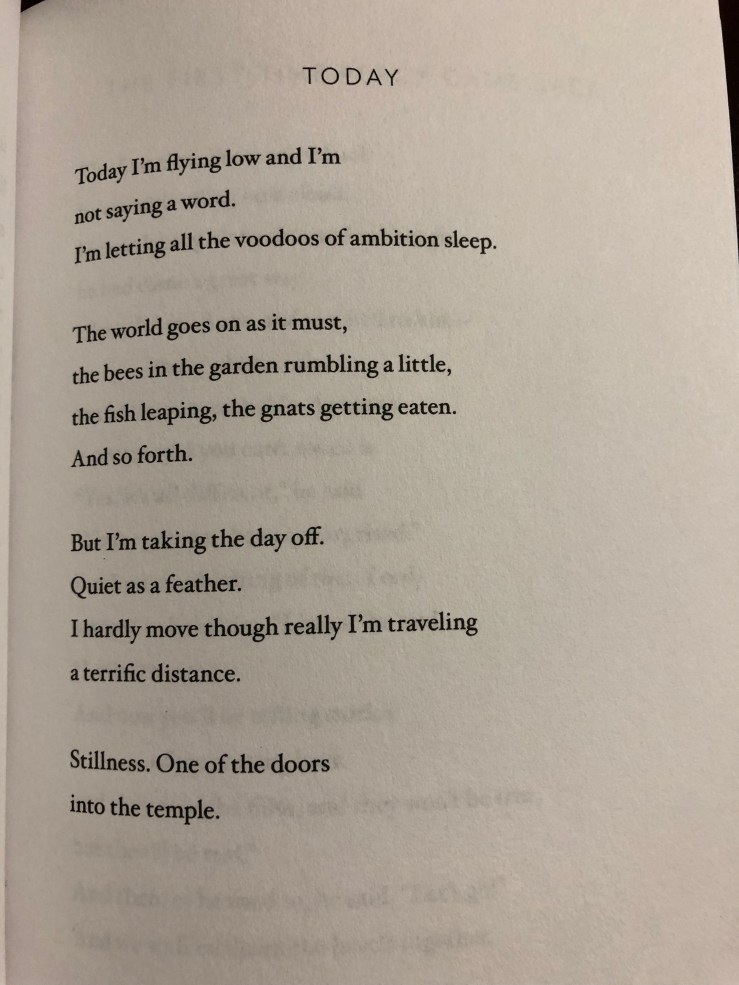
So rather than belabor that point, I’m going to be done for tonight. It feels a little bit like cheating and I’ve made a list of ideas for tomorrow so that installment will not suffer as this one has. And I will leave you with one of my favorite Mary Oliver poems ever…the stillness that I seek is spoken of here. Always grateful for her words, her simplicity and her wisdom. As my words fail, enjoy hers.

(Day 17 — I’m counting it)

IMG_1863.jpeg

vision

I bought my first pair of reading glasses today and while that feels strange to admit (because in my head, I am still like 32) it also feels a bit like a rite of passage. A normal aging thing after all the weird illnesses and meannesses my body has inflicted on me. Honestly, I was a little excited by the normalcy of it. Finally, something that everyone for the most part will deal with eventually!! I wasn’t desperately in need of these glasses. I only really need to wear them when my contacts are in and even then I can get by. I mean, I am able make out the words on my screen or on the page…just not as easily as I once could. So I procrastinated…longer than I should have. I grew comfortable in my discomfort because it was easier than taking the steps of solving the problem.

It was sort of like when I was sick because of my inner ear, my car got out of hand messy. I mean unbelievably so. I was embarrassed just sitting in the car by myself let alone if anyone else had to see it. But I was sick and didn’t have the energy or the desire to fix the problem, to clean it out. So, I ignored the mountain of water bottles and magazines and books and more and just harbored by discomfort because even though it made me sort of miserable it was easier to drive the false facade around than solving the problem, easier than taking the time to clean up the mess inside.

When my ear was a bit of a disaster, I knew there was a surgery that could fix it but it terrified me, so I did everything else instead. I tried every treatment available except the one that would be nearly guaranteed to work. Chiropractic, Acupuncture, Essential Oils, Physical Therapy, TMJ Treatments, and more. All desperate measures to avoid the one definite fix. Why would I procrastinate when help was available? Who knows, really? I could tell you it was because of the cost of the surgery or that it was so close to my brain that it scared me, but the truth is that neither of those is the real answer. I was somehow simply resigned to being miserable and blinded myself to the solution.

I think we do this all the time in various ways. We table our issues, our anxieties, our concerns and just learn to live with them, rather than really dealing with them, rather than taking the steps to actually cope with them. We are willing to accept the false feelings of ease rather than work to uncover what might be a thorny path to healing, recovery, rest or health. Forgetting all the while that though the thorns may sting and intensify the misery in the short term, they are also necessary points along the way to healing…to a clearer path…to the river of rebirth that allows us to cleanse ourselves of whatever ails us.

When I put those glasses on my face and I looked down at my phone screen today to see if they really helped, I was entirely astonished at the clarity and precision of the words on the screen. I had not realized just how blurry things had gotten until a new lens, a new perspective allowed me to see the truth of the matter. And I sat there for a minute just wondering what on earth took me so long and how many more times will I fall prey to the laziness of accepting unnecessary discomfort…

“Autobiography in Five Short Chapters” by Portia Nelson

(Day 13–exhausted from a very long week, but still found a moment to knock this one out. Not my most careful writing, but happy to have it done).

impact

Ask any student who has set foot in my classroom and they will tell you “Mrs. Clark is super passionate about words…words matter after all.” And they would be right, I am sort of constantly in awe of what we as humans are able to do simply in the arrangement and selection of the words we wield. We can brandish them dangerously, carelessly damaging others with rancor and vitriol. Or, we can employ them meaningfully, intentionally provoking thought with depth and weight.

One of the reasons poetry resonates with me the way that it does is that I find myself in constant wonder of the poet’s word craft–of their ability to be so precise in their execution of word economy, while at the same time creating gorgeous imagery or intensity or moments to pause and wonder or heightened emotion or all of these and more. It is the surprise in the organization that gets me, the arrangement I would never have considered that drops my jaw. I love the form that creates the content as much as the content itself.

~~~“Breakage” by Mary Oliver~~~

I say all of this because Mary Oliver died today. Mary Oliver was a poet that I believe, honestly, could reach anyone as she wrote honestly and simply yet somehow in her simple language led readers into the complexity of human emotion and experience. She didn’t require fancy forms or intricate language; she didn’t write beyond her experience, no matter how simple the moments may have been; she didn’t reach for what wasn’t true to her and in maintaining that sincerity, her readers were able to find their true selves in her work.

~~~ From “The Journey” by Mary Oliver~~~

“…

But little by little,

as you left their voices behind,

the stars began to burn

through the sheets of clouds,

and there was a new voice

which you slowly recognize as your own,

that kept you company

as you strode deeper and deeper

into the world,

determined to do

the only thing you could do–

determined to save

the only life you could save.”

In the natural world Mary Oliver sought solace and God and understanding of life and its proverbial mysteriousness and through the natural world she brought the rest of us solace and God and an understanding of life. She opened my eyes to not just the beauty in the world around me but to its nuance and to a new way of paying attention to it. Her words, her insight, her description all still my soul.

~~~“Fall” by Mary Oliver~~~

(the last stanza here is just perfection and will alter your perception of rain forever)

And then there are the Mary Oliver poems that walked me through grief at times where grief felt heavier that what I could shoulder alone. Except, I wasn’t alone. She had shouldered it already. She had walked this path and she recorded it in her writing–with hope, with honesty and with love. Through loss, through illness I have almost religiously turned to Mary Oliver’s work as a sort of prayer when my prayers were sort of lost in the wilderness. I turned to her work to restore my hope and my faith, and she never failed me, not one single time.

 “Praying” by Mary Oliver

“It doesn’t have to be

The blue iris, it could be

weeds in a vacant lot, or a few

small stones; just

pay attention, then patch


a few words together and don’t try

to make them elaborate, this isn’t

a contest but the doorway


into thanks, and a silence in which

another voice may speak.”


“…the doorway/into thanks…” Mary Oliver’s work will continue to be a part of my daily reading, my daily stillness, my daily search for peace in the chaos of the world. My gratitude is without bounds–not just for a life well lived, but for a dedication to sharing that life with others through her words…for the impression she has made in my heart and the impact she has made in my vision and in my life. Mary Oliver may have left the physical world today, but she has also left behind her words–a wealth, a storehouse of beauty and reminders of goodness. And that is forever.

(Day 12…I was so sad to hear about Mary Oliver’s passing today, but in writing about her work, I found so much more. Glad for this outlet that allowed for that to happen)


comfort

So, you know it has been a hard day when I have a fridge full of healthy meal prepped food and I opt to make gluten free blueberry pancakes for dinner instead. I spent hours on Saturday and Sunday working in my kitchen so that I would not make quick unhealthy (read that: fun) choices during the week. Yet, here I am, on a Tuesday (that I have titled Second Monday) finding ways to justify my choice to make and eat blueberry pancakes for dinner instead: “Well, I mean all of that food will freeze so well and will make other weeks easier to prep for…Well, I mean, your jaw has been hurting and pancakes are so easy to eat (ignoring the fact that one of my healthy options was a pureed squash soup)…Well, I mean, you did have a terrible day…”

Evidently, based on my carry through with this pancake plan, I am a very convincing person. I also find myself wondering where the voice is inside of me that wants to be healthier, you know the one who is eternally frustrated over how hard it has been to reclaim fitness since the inner ear debacle devolved into 7 months of slow debilitation followed by surgery and several more months of recovery? I’m just thinking that voice comes from the same brain as the other one and should be pretty convincing too—right? So, where is it?

I feel it is probably important to note here that aside from poetry, one of my most consistent comforts in this life has been food. I’m sure there are healthier habits to have, but food has always been the warm fuzzy blanket to my cold winter’s day (if that even makes sense outside of my own head). This should come as no real surprise, though. I’m a New Orleans girl who was raised in a city and by a family where food is always a topic for discussion in the best possible way. At breakfast we are talking about what we will eat for lunch and at lunch we are mapping out dinner. Food has always been something to look forward to and to savor; a form of communion, as a meal shared with family or friends becomes an almost sacred encounter. Food has always been a bit of nostalgia for me (there is not a grilled cheese that I make today that doesn’t remind me of the grilled cheese sandwiches my mom made for me when I would come home from college). Food has always been a means of communication, of communicating love; standing next to my mom learning how to make her red beans because there was no way to write the recipe–it simply had to be witnessed and then enacted step by step.

When I got married, my husband’s grandmother, who has been my grandmother essentially for the last 22 years now, gave me a recipe book with all of her most prized recipes in it—handwritten. Now, she may have left out some of the secrets that make these recipes quintessentially hers, but that book is physical evidence to me of the importance of food in a family and its role in communicating love from one generation to the next. Every time I see those painstakingly handwritten recipes, I see her heart written across the pages. I see her desire to be remembered by the things she cooked and I think, you know, if people only remembered me for the things I cooked, I would really be pretty okay with that.

I mean, I’ve never been above using food to win someone’s heart or to brighten their day (I do, after all, keep a giant jar of seasonal Hershey’s Kisses in my office because I know if there is chocolate, students will stop by and say hello…and take some chocolate). I don’t think it is a coincidence that the man asked me out on our first date all those years ago on the same night I made him a batch of Rolo cookies (literally, dark chocolate cookie dough wrapped around a Rolo and baked so that the caramel melts in the middle–totally date worthy!). I don’t think it is a coincidence that my sister always felt like my sandwiches tasted better than hers because when someone else makes you food, it does taste better. You feel loved and cared for in the unselfish moment of the gift. And we gift each other food all of the time–when I had my surgery my sister and my mom nursed me back to health again with homemade deliciousness that took the sting out of bedrest away and only made me feel wrapped in warmth and affection.

So, yeah, I made blueberry pancakes for my dinner tonight. So what? They were delicious and my kids sat at the counter and cheered me on…I think in part because it meant they wouldn’t have to smell my lentil soup warming up, but also because they knew that small creature comfort, that small bit of self care, was a bit of grace I could extend to myself and I think there are worse examples to set.

And because a food poem seems appropriate, here you go!

Pot Roast by Mark Strand (See the excerpt below…but also, read the whole thing!)

“These days when there is little
to love or to praise
one could do worse
than yield
to the power of food.
So I bend

to inhale
the steam that rises
from my plate, and I think
of the first time
I tasted a roast
like this.”

(Day 10…done!)

unison

It began with a solitary voice.

She stood in front of the congregation, no music, no accompaniment…just a lone voice singing out, filling the silence.

“As I went down in the river to pray/ Studying about that good old way/ And who shall wear the starry crown/ Good Lord, show me the way!” 

Then suddenly two more voices joined hers and there were three voices singing together, filling the silence. Two by two, sisters, brothers, mothers, fathers, walked up and joined each other standing side by side singing. As more members of the choir and other church goers joined in and the sound of those beautiful voices singing in unison crescendoed, I found myself overwhelmed, tears welling.

I am easily moved, so tears like this aren’t uncommon. But today was different. Today, it wasn’t the words or even the beautiful voices. Today was a realization.

~~~

We live in a world where voices seem more often to scream out in discord rather than to join together harmoniously. Lone voices would rather be correct than work together to uncover what light and goodness might come from that union. Barriers go up so fast and they are built so solidly that it becomes impossible to even make sense of what is being said on the other side–we don’t hear the song, we just hear the noise…and the noise is loud. It feels unknown and unfamiliar and uncomfortable and what we don’t know frightens us so we fortify the barriers instead of asking questions, instead of seeking to understand. Our barriers are decorated carefully with words, phrases, posts and reposts so others will view them with reverence and maybe even fear. In their reinforcement, our barriers make us feel important. They make us feel right. They convince us that we don’t all have to live in this world together, that we really can separate ourselves and not interact, let alone interact civilly.

~~~ poetic interlude care of Robert Frost~~~

My students are currently conducting a little study on sonnets. One of the greatest common factors in the earliest sonnets is a diligent rhyme scheme. My kids tend to  love this quality because to many of them, rhyming poems feel like “real poems”…don’t get me started on this… Those rhymes echoing the same sound as the end of the line before, adding emphasis, adding rhythm also add a bit of comfort for my students who sometimes find themselves disconcerted by free verse. The earliest poems and stories we come to know in life rhyme, the first poems we write and are praised for often rhyme and so the rhyme in these sonnets brings on nostalgia for what was once deemed proper and correct. Breaking free from this concept that all poetry rhymes kind of terrifies some kids. It calls them to venture into territory they aren’t certain of, begs them to tear down barriers, requires them not to rely on the echo, on the creature comfort, but to create something that resonates with those around them for other reasons–meaningful reasons they must consider and craft. That is difficult work.

~~~a sonnet interlude care of Elizabeth Bishop~~~

I was working with a group of third through sixth graders at church one week and in the middle of a pretty lively conversation about judgments and bias and stereotypes asked them what it really means to love our neighbor. The inevitable eye roll and rote answer came my way. “Treat others the way we want to be treated.” Yes, but what does that look like? If we are truly called to love one another, what does that mean? How can we live into that? They thought for a bit and were hesitant to respond but once they did, the answers rolled in beautifully and honestly–“well, it’s hard because we are supposed to love everyone and not everyone is nice” “it means we are supposed to be kind” “it means that if someone is sitting alone at recess, I should go sit with them” And more…answers and examples unique to their daily experience came pouring in. It was a good reminder conversation with kids who have been taught this idea all of their lives. I ended the class by asking them to think about what specific actions they would really need to take in order to honor this commitment to love our neighbors. I joined in this thinking because I don’t think any of us are ever too old for this kind of intentional living, intentional loving. We all agreed that the things we thought about would be tough, but so is living in a world where people shy away from loving others just because sharing that love, sharing that grace, sharing that kindness feels like a risk. But we also agreed that it would be a risk worth taking.

~~~poetic interlude care of Naomi Shihab Nye-stick with this one, it is worth it~~~

I wasn’t even going to attend church today. I didn’t feel well last week and have so much work to do and so much that I could have gotten done during that time that would have made Monday far easier than it is going to be. But, my husband said the choir would be singing this song and it would be different so I went.

As I sat there in the crowd witnessing the growing number of voices joining in together to sing, my tears welling, I realized that there were no barriers. One lone voice singing out goodness was magnetic, and planned or not, others joined in, and like a light filling a dark room, the joy and goodness in their voices permeated hearts (or maybe just mine, but I’d like to think others felt it too). They weren’t echoing each other–Sure, they were singing together, but each voice sang out its own unique tone in its own unique way. There was no hiding in the choral unison because as voices joined in, they could be heard for who and what they were. Yet they all still made music, beautiful music together. There was love. That group of people, knowing them as I do, represented viewpoints and opinions that span the spectrum. They represented varying ages and identities, varying backgrounds and abilities and they stood together in agreement to sing a song about renewal, welcoming, and prayer. It was a visualization of what we need most in this world today, a visualization of what we could be–of what we were, if only for a moment and not just in a church but anywhere, everywhere.

And it was beautiful.

(Day 8, done. I’ve come to spend my days searching for something to write about since I’ve started this challenge instead of just waiting for inspiration to strike. It’s a good process I think but today was a moment in and of itself and begged me to put words to the emotion. Always the best when that happens!)

awestruck

As an educator, I’ve long realized that my students are brilliant beyond all expectation and that if I will just get out of their way, they will prove that truth time and again. It’s the dismissal of my own pet projects and the getting out of the way that can be tricky. There are certain works and assignments that I simply love to witness kids interact with and grow from, so the temptation to micromanage the curriculum can often be difficult to dismiss.

This is particularly true in my AP Literature class. It’s less a temptation in this situation and more a burden placed by the weight of the test in May…you know, the test that is made without knowledge of my kids but that determines whether they will receive college credit without regard for the fact that maybe they have completed important, intelligent and profoundly thought provoking work all semester but maybe came into the test not feeling well. An entire year of work denied in four hours. I digress. My point is that given the import my kids place on this test, I feel an obligation to find a balance between teaching a really solid literature course and also instructing on the nuances of the test.

Every other course I teach roots itself deeply in the choice offered through reading and writing workshop, but my AP class has always been a little bit different. Choice has been present but within parameters–often set by me (particularly when it comest to reading).

This year has been a bit different. We still share a central text every now and again so we can discuss and learn from each other as a whole class. But our reading for the most part has existed in book clubs. And while, yes, there have been literary analyses that were written, this year we have also participated in a true writer’s workshop. Students set writing goals for themselves, selected a style of writing and topic that would assist them in achieving their goals, and then set to work. I was present for conferencing and teaching one on one as they went through the process.

What I found incredibly intriguing is that so many of the kids were inspired to write based on the books they had chosen for their book clubs. A few students read Layli Long Soldier’s poetry collection entitled Whereas. This beautiful book of poetry reveals the hard work of the poet, and the intricacy of Layli Long Soldier’s craft deepens the connection of the reader to the work, to the meaning (and also opens eyes). As much poetry as I have shared with my kids over the years (there has been so much poetry, trust me here), there was something magical about their independent reading and interaction with Whereas. Not only did they appreciate the text and have riveting book club discussions, but they also all decided that their writing goals would include exploring what they could really do with poetry.

Now I have to say that historically, when a student asks to pursue poetry for independent writing, questions like these are often involved… “So, like, how many poems do I have to write?” “So, 3 or 4 haiku would count, right?” “But what if I worked really hard on these two poems? Two would be enough, right?” This group of students, however, asked an entirely different set of questions… “Can I include an intermission in my collection?” “Would it be alright if my collection had 3 parts?” “I’d like the third part to be interactive for the reader–is that too creative? Will people get it?” “Can I play with spacing on the page and punctuation if it works with my point?” Meaningful questions about the work of a writer–questions that reflected thought and consideration and investment. I was dazzled.

And the outcome? Well, one student crafted a 62 page, three part collection of poems that illustrated the transition from anxiety/depression/hurt to taking a breath to finally healing (the healing is approached through an interactive set of poems and directives that aim to help the reader work toward healing rather than simply acting as a passive observer). Another student, who had never attempted to write poetry and maybe hadn’t even really attached himself to any piece of writing before, composed his own multipart collection in which he plays with spacing, punctuation and word choice in a rather magical way. His continued affirmations that he was so proud of this work only made its worth shine more brightly.

One student, intrigued by Jean Toomer’s style in Cane, attempted an entire essay composed in prose poetry, and get this, merged the airy, imagistic language with terms and ideas associated with Calculus and Physics. It was utter brilliance. Stunning to read. I’m pretty sure I audibly gasped at certain points. Again, the pride she took in her accomplishment was remarkable. She wrote, “I read it out loud to myself for the first time last night and I heard growth as a writer, thinker and viewer of the world.”

Finally, another student who had been frustrated and a little bored by Camus’ style in The Stranger realized that his own writing reflected this very same style. He went back to the short story he had been composing in workshop with a fresh eye and revised from there. His self reflection included these words, “Who knew I would end up liking to write? Probably you, Mrs. Clark.”

And I’ve only mentioned the kids whose writing was inspired by their reading…For the sake of space I haven’t  included others who played with style, development, genre, imagery and more apart from their reading, but with equally impressive outcomes.

Here’s the thing. I could never have created a set of directions that would have led to the crafting of any one of these assignments. My brain would never have gotten there. And if I had by some small miracle, actually assigned even one of these pieces, the investment and engagement that was palpable in the classroom simply wouldn’t have existed. Why? Because they would have been working for me, for the grade. They would have been doing the work that I asked them to, in the way that I told them to and it would have been good but it wouldn’t have meant so much. Teacher pleasing is not engagement. It gets the work done, but it doesn’t resonate, it doesn’t linger.

The student who wrote the 62 paged piece has now, long after the grading is done, methodically increased the collection to 120 pages and is considering inserting photography as well. This piece is hers and hers alone. Its genius stems entirely from her mind and her process. The small intricate touches she is adding don’t reflect the work of school; they reflect the work of her heart.

The writing turned in during this writer’s workshop represents the inspired work and thinking of students who, when given the chance, were ready to prove without question the value of choice and freedom, the value of engagement and ownership.

And as a result, despite knowing these students for the last four years, after shifting my role completely to consultant rather than instructor and after the joy of witnessing the results, I find myself quite simply awestruck.

(this piece really needs to be longer…and less clunky…I don’t have an ease about my writing when I write about my classroom yet–something I am working on over these months… Day four writing, done!)

Enjambment

—in poetry, when a sentence or phrase overflows its singular line and pours into the next (and maybe beyond) before meeting with a solid pause and some kind of terminal punctuation…

As I sat in my office early this morning considering whether I really needed to teach the term “enjambment” to my AP seniors later in the day, I suddenly found myself daydreaming and spiraling away in wonder from the task at hand.

My affection for poetry runs deep. And I’m not even sure there is a tangible way to describe why. For a while, I thought it was because I simply loved the puzzle of analysis or the way writing a poem allowed me to lay my emotions down on the page. But as I began to include more poetry in my classroom–and not just poems that I was choosing because “they were important to study” (how do you even qualify that?), but poems that students sought out because they were struck by the words on the page, poems that we read aloud and then lingered over, poems that made us smile or think or pause, poems whose careful construction crafted something unexpected–in those moments, I realized that I loved poetry because it was, in fact, the greatest teacher in my life.

As a teacher of writers, poetry has instructed me to choose and arrange my words with care and how to apply punctuation in all of my writing to deepen meaning and understanding. As a teacher of readers, poetry proved to be a bridge rather than the barrier it is always portrayed to be. So often the assumption that students will hate poetry prevents us from really giving it a chance in the classroom. We relegate it to a singular unit as though it has no place in our everyday lives. Except that unit is a false metric. Poetry presents a perfectly sized challenge to our readers–all of our readers. In their brevity, poems allow us to better understand what it means to be a writer and also grants us the opportunity to better understand ourselves, the world around us and our place in it without alienating or overwhelming us with verbosity stretching from margin to margin, page after page. (there’s so much more for me to say here–but it’s not my point, so I’ll return to those thoughts another day…it’s not like I’m not writing everyday at this point…king cake is a powerful motivator!)

But, today, as I considered the word “enjambment” my brain strayed from line breaks and end marks in poetry to the moments we consider end marks in our lives–and I realized that maybe they aren’t the clearcut extended pauses we hope they will be, maybe there is nothing “terminal” about these moments we see so clearly punctuated. And maybe that’s the best possible circumstance, to live a series of enjambed lines.

The more I thought about it, this truth grew more brilliant–it would seem my  life has been exactly that: an extended thought that overflows the expected boundaries.

I can’t isolate events without realizing that every moment I’ve lived, every hardship endured, every joy celebrated has influenced and shaded in some way every moment that followed. Because each one of these experiences has molded and shaped me into the person I am today. There may be a brief pause for momentous occasions as there would be to denote the end of an unpunctuated line of poetry, but then the poem keeps going, we keep on living–defined by the lines above, defining the lines to come. I like this so much better than the cliche of “starting a new chapter in life” as though you need to completely close out one period of time in order to move into the next. As much as I joke about how great it would be to just close the chapter on my inner ear illness or the years where I thought we would never have a baby, I also know that my perseverance and much of my strength emanates from having endured those years. To view healing as a complete stop and better health as a new and entirely separate enterprise would be to deny the truth of my experience, of my life…and the wisdom and compassion gained in living those days…it would deny me the continuity and movement of each experience flowing into the next.

I didn’t end up teaching enjambment today. I needed more time to figure out how to grant my students the opportunity to see it as more than just a literary term with form and function. I didn’t just want to give notes and examples. There seemed to be greater opportunities available. So we will wait.

I suppose that it might seem I was wasting valuable planning time in this wandering distraction. Yet, I feel like it defines the real reason I love poetry…it grants me the space and time to be still and to wonder. And as much as I love gifting myself with those moments of freedom as I wade around in a poem, granting my students that opportunity to think freely and for themselves and then witnessing the outcome is infinitely more valuable. And certainly isn’t an opportunity to be caged in a single unit, taught once a year.

(This one was tough to write. I knew what I wanted to say but by the time I sat down to write it, I was exhausted and the thoughts jumbled. But day 3 is done and I’m proud of that!)


Hope

Someone asked me just before the New Year announced its arrival with colorful displays and cacophonous litanies, what word I would choose as sort of a mantra for the year. I had to pause (it felt like a rather weighty decision after all, I should be thoughtful).

I considered the previous year, 2018. This was a year that tested me in ways I’ve never been tested. My health decided to forsake me and as desperately as I tried to swim up through the mayhem of new and damaging symptoms, I only seemed to sink deeper. I was committed to not giving up my life and livelihood even though its quality had been diminished. I fought fiercely to put on a smile and to tell people not to worry because I was fine when that was the farthest thing from the truth. I made jokes. I taught my students. I cooked meals. I attended soccer games and plays where my own kids were competing and performing.

Well, a shadow of me did anyway.

I realized this Christmas that other than remembering how distinctly terrible I felt and the anxiety that swallowed me up as a result, last Christmas was a vast black hole. Because you see, while every picture reveals a woman smiling and being active and grateful for her life and those in it, every picture also hid what was happening on the inside.

On any typical day, I am without fail annoyingly optimistic. I own this trait–and while it can be less than realistic at times, it is also the only way I care to look at this world and my place in it. But in the days between November 2017 and June 2018, not only did my optimism fade, but so did my hope that I would ever be well or whole again…that I would ever hear normally, that I would ever have a non-dizzy day. And as my hope withered slowly, so did my spirit. And as my spirit dwindled I no longer recognized the person I had become and quite honestly, this terrified me.

And then, as though a gift from above, I was offered and received the surgery that fixed most of the physical issues with my inner ear. It was overwhelmingly successful–I couldn’t have ever imagined I would feel this good again and while incredibly grateful, at some point I realized that even though my body was seemingly “cured” (even if only temporarily), I wasn’t healed. There was damage that no surgery could repair. The rebuilding of my trust and my hope and my optimism was going to take time–it was going to take effort…so. much. effort.

I began to think of Emily Dickinson and how she described hope–

“‘Hope’ is the thing with feathers-

That perches in the soul –

And sings the tune without the words –

And never stops – at all -”

So I knew hope had to be there…maybe I hadn’t listened carefully enough in the furious “Gale” of those sick days to hear it singing (or maybe I was simply too tired to make the effort to try). But that’s the thing about hope–I don’t doubt that it was always waiting for me to seize it up enthusiastically and allow it to carry me forward. I don’t doubt the power of its force and I don’t doubt that it is there for every single human in this world who seeks it out despite hardship–hope is certainly not biased in who gets to partake. I also don’t doubt that hope, as powerful as it is, lacks the ability to swoop up an unwilling passenger–hope is not for the bystanders, it is an active state of being.

I lost hope because I grew too weary to fight harder to seek and to maintain and to nurture and to treasure it. I lost hope because I thought hope had forsaken me–I removed myself from the equation and I was too blind to even realize my role in this. And once I felt betrayed, once I felt abandoned by hope, all I could feel was sorry for myself. And this was new territory. It took me realizing that I needed to seek hope out for it to sing loudly enough for me to hear.

So, in my pausing to consider what word should define my new year, it was hope that reverberated in my mind and in my heart. This is a world that commands hope for survival. Even when you are not sick, sometimes the world seems to be. It can feel easier to give in to the pessimism, to the rancor, to the weight than to fight to see the goodness humanity still possesses and creates. But it is our job to see that light in others and in the world, to amplify the good, to sing the song of hope so loudly that everyone else cannot help but listen to its melody (and hopefully hum along). And for this year, and beyond, Hope (seeking it, singing it, living into it) is my word, my guide, my path back to myself and who I truly wish to be.

(This podcast is a really great listen for everyone but especially if you are suffering without cure in sight but might benefit from understanding the difference between being “fixed” and being “healed”. It has been an integral part of my understanding on this journey.)

Day 2 of Carnival Season writing challenge complete!


A ticket for my destination

“I was in crazy motion

till you calmed me down…”

(“Something So Right”, Paul Simon)

To the observant eye, Jazz Fest 2006 was a composition of strange juxtapositions. The pain of loss was fresh—surreal but powerful, pervasive. But, the city, nurtured and healed by its heart and enduring community, was reaching for recovery. Jazz Fest activities offered reprieve and felt almost normal, as though for a moment you might forget. But even amid that semblance of normalcy there was a constant haunting reminder that outside the gates of the Fair Grounds lie the lingering stench of floodwaters that sat for too long, houses (lives) left in shambles (unrecognizable), an emptiness left by those displaced or worse. There weren’t bookmarkers to measure this loss.

Inside the gates, however, was something else entirely–a vivid display of all that we are and have been; a brilliant indication that we would in fact be okay, we would rise again. The food, the music and the community of people joyously gathered together in spite of it all worked to heal something inside of me that day. Something I wasn’t so sure could be healed.

I went to that particular day of Jazz Fest as a bit of an unwilling participant. In addition to the devastation the storm brought to my family, in the months leading up to the storm, my husband and I had lost our son midway through the pregnancy and another baby to miscarriage. My body, my spirit was battered and seemed to understand a depth of loss that my empathic nature could never have predicted. It seemed permanent damage. And maybe on some level it has been.

Except not entirely.

I went to Jazz Fest that day for one reason only: Paul Simon. I was in a funk. I was sad…for myself, for my city, for my parents…and I just wanted some do-overs.  Paul Simon’s music does something to me that I don’t have proper words to explain. His lyrics are poetry in a way that not all lyrics can hope to become. His awareness of words, his attention to how they work together, to how the sounds of the letters and their repetition create a rhythm just as the music does, how his words create a moment for the listener–first inviting you in, then residing in your heart, in your mind. That is what poetry does…that is what Paul Simon’s work has done for me…storied my life, guided me through.

As I stood in that field, Paul Simon, playing songs we had all heard before, somehow uplifted the city of New Orleans, and I was delivered to a sort of rebirth…a baptism if you will, but not by water (there had been enough of that). It was music that brought healing and comfort that day and carried me from the funk to the other side…to a place where I could see the possibility of goodness again. I stood in that field not knowing if I would ever have children, but knowing that my spirit was healing and that no matter what, I would be okay.

“My life is made of patterns
That can scarcely be controlled.”

(“Patterns”, Paul Simon)

Thirteen years later, I find myself in the midst of a new sort of recovery, facing the hope of yet another rebirth.

I spent so many months of the last year disabled by hearing loss and vertigo…and after becoming resigned to the fact that my hearing could be permanently damaged but I might still potentially hear the movement of my eyes forever (I promise, the novelty of this idea is deceiving)…after spending months trying to memorize the sound of my children’s laughter rather than be annoyed by the noise of it and carefully studying voices of loved ones before I no longer heard them as I should…after learning not to trust my body or my balance and after fearing loss of so much, I have come to find my body healed (at least for now) by a surgery that seemed unfathomable for so long.

Yet, while my inner ear is currently in a more cooperative mood, my mind and spirit are still trying to catch up. On any given day, at any given moment, I find myself suddenly stricken with absolute panic over the possibility of symptoms returning despite the fact that, everyday, my life is a little closer to normal. Or, I find myself unexpectedly emotional at the weirdest times when gratitude for health and healing overwhelms me. I’ve learned what it means to be a fighter over time, and while I am weary of having to continually prove my brawn, I furiously battle on through the weight of this anxiety and these grateful tears.

In the midst of all of the unknowns of this illness though, tickets went on sale for Paul Simon’s New Orleans show of his farewell tour.  We bought floor tickets without thinking too much about it. I had no idea if I would be able to stand in a crowd or stand at all…I had no idea if I would be able to hear well enough to enjoy the show…I had no idea if I would be too sick to attend. All I knew was that if Paul Simon was coming to New Orleans, I had to be there.

Buying those tickets was a leap of faith.

Recovery has not been an easy road, but my beacon all the way through was knowing that in just a few short weeks, I would be in the New Orleans Arena vertigo free, with my hearing restored and once again having my soul replenished by the beauty and richness of Paul Simon’s lyrics and music.

As I sit here tonight typing these words (the night before the concert), a tropical storm looms in the Gulf (I promise, this English teacher has assigned more meaning there than should be).  A bit of a reminder for me that storms will come–they might flood, they might destroy, they might bring uncertainty and fear and it might be hard to see in the midst of them or to know when it will subside, but there is another side.

There is always another side.

Tomorrow night, when I walk into that arena, I will be stepping not just into a shelter from the storm, not just into a brief respite, but I will be stepping toward the consolation that will be my reward.

Sometimes it’s the moments that make the movement

The most important moment in my high school career had nothing to do with grades, awards, or really school itself. And I guess, if I’m honest, it was more of a realization than a precise moment. In my memory though, it feels like a decisive point in time.

Somewhere in my sophomore year, a determination settled in my heart: I didn’t care what other people thought of me. I was going to be myself and if that wasn’t enough, then I didn’t need the weight of that judgment in my life. And in return I would quit (or try my best to quit) judging other people.

It wasn’t defiance or some kind of a front or a wall that I was putting up—it was the truth of my heart. It was me making peace with myself.

~~~~~~~~

I’ll never forget the look on his face. He walked into my classroom exhausted and distraught and ready to fall into pieces. He looked at me and said, “I’m here because I knew I wouldn’t be judged and I need to talk.”

My heart was ready to carry the weight it would receive. I was ready to listen and accept whatever it was he needed to share.

I had already accepted him and nothing could change that. Thankfully, somehow, he knew that.

~~~~~~~~

“I’m a non-writer and a struggling reader.”

Those were the first words she spoke to me as she entered my classroom on the first day of school. I had never heard a 15 year old identify herself in these terms before this moment. She introduced herself this way almost as if this information, that she believed so intently, was more important than her name.

I told her, “Well, we will see about that.” I gave her a smile and made a note that her first reading and writing goals would be nothing more than to work on her confidence.

Doubting the possibility of any kind of growth, she was skeptical.

I knew better. I could see what she couldn’t about herself.

~~~~~~~~

It was May 2014 and I had just become a Heinemann Fellow. I had no idea what that meant exactly and when people asked I am pretty sure my answer was some variation of “I think I will do some research and maybe write a little bit and I know I get some free books.”

I never even really expected to be chosen—I just wanted to try for it. I had never written professionally. I knew I liked to write, but I didn’t think any of my writing was very good.  I didn’t consider myself a writer for sure. A teacher of writing, yes. But a writer, no way.

So, there I was at the Heinemann reception at the ILA conference in New Orleans. I didn’t know a soul in the room, but I was totally awestruck because so many of the teacher authors I admired were present. That whole high school confidence “I don’t care what people think” thing was out the window…I was nervous! I wanted to impress, to fit in and I couldn’t see a way that I could ever measure up.

But I was in a room full of teachers and, you know, teachers have this sensibility about them, a certain kindness.

I was introduced to Ellin Keene early in the evening. She would be “in charge” of the Fellows—we were her babiesJShe had been one of the readers of my application. Upon finding this out, I immediately began to summon up an apology for not having submitted professional writing, only a creative personal piece. Before the words could exit my lips, Ellin said, “You are a writer, you know that, right?” and proceeded to talk about how my piece had moved her.

I was a writer? I was certain she was thinking of the wrong person, but she knew my work. It had stayed with her. It had meant something to her. I was a writer.

Confidence restored. I haven’t looked back.

The power of a teacher.

~~~~~~~~

We all have stories to tell. Stories of our interactions with a text…stories of our experience in the world…stories that help us figure out who we really are…stories that help us heal…stories of endless variation. This includes our students. Grades and fears of judgment/fitting in and getting into college should not limit the possibilities and potential of those stories.

I think sometimes, as high school teachers, we forget that we teach kids. That is not to diminish their intelligence or to challenge their maturity or the value of their voice. I am awestruck by high school students every single day. I think they are brilliant and funny and worthy of being heard in this world. That is why I teach them. That is why I have agreed to work in an administrative role in addition to my teaching duties–because I think so highly of high school students.

But at the same time, we get caught up in material and in testing and in expectations and we forget. And our students have this uncanny ability to appear so grown up on the outside that it becomes easy to overlook the fact that on the inside they are still just kids trying to figure out who they are and how they fit in the world. And they are trying to accomplish this in the midst of enormous pressures from the outside. Our kids, our students, are faced with impossible expectation for what it means to succeed, to fit in, to be smart, to be normal, to be accepted.  The last thing they need is another grown up in power proving to them that they will never measure up.

Our students sit in front of us—a composition of a whole lifetime of stories and experiences that have shaped their literacy lives as well as the person they have become over time. They are still growing and still determining the person they want to be. They need a little extra grace and some positive words from their teachers. They need us to be able to see beyond the facade of the moment and understand that there is so much more complexity to them. They need us to consider them—not as students or as a job, but as human beings…even when it is hard…even when they skillfully deliver attitude or appear entirely apathetic…they need us to see beyond the show.  They need to be accepted.

Is that always easy? Does that mean we don’t usher them towards any kind of growth? Absolutely not. Accepting people for who they are, as they are, is never easy.

There are so many ways to grant those positive words though—I’ve written before about writers notebooks, but they extend a gorgeous means for kids to figure out who they are, how they feel, and to begin to accept themselves (they are pretty handy for adults too…just saying…) But also, as teachers, we can name kids as readers and writers without negativity and be able to speak specifically to each about why. We can write small notes of response and reflection on their work that extend the insight they don’t have into their own work instead of simply marking a rubric or issuing a grade, We can ask about how they felt as they were reading and writing and then we can reassure them along the way. We talk to them sincerely about the unique gifts they bring to writing (and to reading and to the world at large)—to let them know that not everyone else can do what they can.

It takes a little time. But these are the words they will carry with them. The time it takes us to offer this encouragement is worth the lifetime of effect that encouragement could have.

~~~~~~~~

I think Mary Oliver’s “Roses” had it right…

“Forgive us,”

they said. “But as you can see, we are

just now entirely busy being roses.”

(http://www.stmarksbuderim.org.au/poem-of-the-week-roses-by-mary-oliver/)

~~~~~~~~

Having finally recovered from six months of debilitating vertigo, I finally had the chance last week to sit down with my youngest son and watch The Greatest Showman. My kids absolutely adore this movie and this soundtrack so it was fun to get to watch it with him.

We were sitting together on the couch when the song “This is Me” (written by Benj Paskek, Justin Paul) was performed and I got a little teary eyed. He was worried for me. He said, “Mom, why are you crying? This is everyone’s favorite song! You should love it!”

I did love it.  It was perfect. We paused the movie so I could explain that all I could ever want in this world is for him and his brother and every kid I teach to feel this way:

“But I won’t let them break me down to dust
I know that there’s a place for us
For we are glorious

When the sharpest words wanna cut me down
I’m gonna send a flood, gonna drown them out
I am brave, I am bruised
I am who I’m meant to be, this is me”

I’m pretty sure he thinks I’m just a sap who cries at weird places in movies, but sometimes it’s the small moments that create the movement.  Felt worth the conversation to me.