Step out of the Shade

Last night, I went to church. And I sat there alone (yet with my family) in the dark solitude—in a sort of helpless silence.

It was Ash Wednesday and I had been planning to be there for weeks. I honestly cherish this moment of sitting in contemplation, in consideration of who I have been and who I am supposed to be…who I will choose to become and why. But this year, this moment of post Mardi Gras peace and calm held a different weight, a much heavier one and I found myself a bit lost.

I entered the sanctuary heavy hearted. The afternoon had unfolded unexpectedly into what were unfortunately familiar moments of school violence, brokenness revealed, and grief beyond measure. As a teacher—honestly, as a person in the world—my concerns were past counting. I worried about how my students, on holiday this week for Mardi Gras break, were processing all of this. I worried for my own kids who I hadn’t yet figured out how to explain this news to-as if there is an explanation. And I worried for their teachers who so carefully watch over them every day of the school week. I worried for my own helplessness in protecting the lives entrusted to me in the event of a situation of this magnitude on my own campus (because courage, swift thinking, and calming words can only go so far when weapons have fallen into violent, angry, hurt, or helpless hands).

I didn’t have the energy to be angry yet amid this flurry of concern, though I knew it would come and I knew I would need to direct it effectively or it would be a wasted emotion, serving no meaningful purpose.

So, I sat and I tried to pray, to turn over the worry, to ease the ache, to begin a contemplative process of seeking a way to change minds and make a difference…to find the words needed to convey that the lives of our children are not to become the fuel and substance of a political argument mired in and dominated by selfish desires. The lives of our children should be valued in a way that clears our vision and allows us to rise above ourselves in order to work together to keep them safe, even if only at school—for the love of all that is good in this world, learning in a free country should not be a dangerous endeavor. The lives of our children, of all of our children, shouldn’t be tied to agenda, they should be tethered to our hearts.

Yet, prayers wouldn’t come. I didn’t even know where to begin. My mind was so cluttered. So I just sat there in quiet reflection, which I suppose is a form of prayer anyway, and found myself circling around the same three words—a sort of desperate cry from within for comfort, clarity, and courage.

In the midst of all of this, Gwendolyn Brooks’ “truth” came to mind. The imagery she uses in this poem seemed particularly appropriate to the moment and a means of explaining why comfort wouldn’t come. She begins her poem with these lines, “And if the sun comes/How shall we greet him?/Shall we not dread him,/Shall we not fear him/After so lengthy a/Session with shade?”

Here’s the thing, the sun is here, and it is hot and it is revealing, allowing nothing to be hidden and demanding to be noticed. It is uncomfortable for those who have been lounging in the shade to “Hear the fierce hammering/Of his firm knuckles/Hard on the door,” but we can no longer “…sleep in the coolness/of snug unawareness.” It is time to wake up to the reality of what is happening in this world that we have created and to the reality of what we are doing to each other and to our kids.

Gun violence in schools (and not just in other people’s schools—this can happen in any school) is screaming at us like a child throwing a tantrum and it is not going to be resolved through single-minded pettiness. We are all accountable in this conversation and it begins with opening serious dialogue intended to find a means to successfully combat gun violence and continuing into de-stigmatizing mental health, providing appropriate resources and education, exploring the social media impact, and so much more. The world is a complicated place and the last thing it needs is us fighting over saving the lives of our kids while keeping ourselves comfortable. I feel like this issue is pretty clear—are the lives of kids important are they worth protecting and if so, what are we doing about it?

But at some point, we cannot continue to just talk about this. Action needs to be taken and the onus of making that happen falls to each and every one of us. Not just to teachers and parents and students—to all of us—this is a national crisis and we need to step out of the “propitious haze,” see the truth, and start doing something about it. Not because we are afraid (acting out of fear is dangerous), but because we shouldn’t have to be.

(other poems that I’ve been looking to as I wander seeking clarity include—Elizabeth Alexander’s “Praise Song For the Day” and Maggie Smith’s “Good Bones” as well as for some reason Jennifer Grotz’s “Poppies”.)
Poetry is a human thing

So, it’s been a while since I’ve written. There’s no real explaining it other than to say that this poem reveals a bit of where my frame of mind and heart have been…“mydreams, my works, must wait till after hell” (Gwendolyn Brooks)

I’ve been sick. Not in any terribly dire way—just in a terribly disruptive way. My inner ear has been unusually and relentlessly unfriendly for the last few months bringing about frequent periods of hearing loss, imbalance, and vertigo. These symptoms have haunted my days and stalked my spirit, even when not present, for the last five years. They weaponize themselves further with feelings of anxiety, fear, helplessness, and most recently, because of their refusal to retreat, hopelessness. It was difficult to see the rather hopeless path I was walking as my mind was foggy and focused on simply making it through each day. It wasn’t until I was granted a few days of feeling well recently that I looked around to realize I had arrived some place unfamiliar to my bright, optimistic, unconquerable spirit. I couldn’t see my way out and to be honest, I wasn’t sure I had the energy to try.

But I knew what was missing—I wasn’t reading poetry…I wasn’t writing…I wasn’t myself. And that had to change. The trouble was that without realizing it, as Brooks writes, I had stored “…my honey and…my bread/In little jars and cabinets of my will.” And apparently, I had placed them on the top shelf, out of reach. They were too important, too critical, too central to my being and I refused to tarnish them with the ashes from which I hadn’t found the strength to take flight.

I would wait.

And then I realized the veracity of Brooks’ 5th line. Two short sentences, one line of poetry; a line divided into simplicity, while burdened by the weight of truth—my truth. “I am very hungry. I am incomplete.”

Poetry and writing are part of my being. Without them, I’m hardly whole and without them I find it hard to breathe and impossible to move. Sure, I was still physically getting through my days and I was smiling through as many of them as possible, but my spirit—the intangibility that ignites the fire within my heart, eyes, thoughts—was starving, weak and waning.

Returning wasn’t easy—I had to make myself do it (and as you can see by this not so uplifting piece, I had to work through some stuff as I did). But, the more I read, the more I write, the more alive I begin to feel and suddenly health and hope seem possible again. I’d be lying if I said I felt fully invigorated because I read some poems and sat down to write, but I’m on my way—I’m on a better path and my jars of bread and honey are getting easier to reach and open.

I shared Brooks’ poem with students last week as we were opening a study on the impact of justice (or the lack thereof) in our world and on the individual. It’s always tricky sharing poems I’m so personally attached to with kids. Inevitably, those are the poems that evoke initial student responses of “this is ridiculous” or “this is why I don’t like poetry” or my personal favorite, “the poet is wrong” (though this does bring up conversations of empathy and questions of when do we have the right to deny the feelings of others—and it also brings up the opportunity to discover what can happen when a poem is read multiple times so that its words are no longer being decoded and its ideas and truth become present and palpable). But this piece felt important to our work because it reveals that justice isn’t something that exists solely in the courthouse and with lawmakers. So, I brought it to my kids. I wanted them to connect with the poem, to dig in and understand it, to feel its worth and weight. In order for that to occur, they had to be free to respond honestly, in their own way, and in a safe space, one that was theirs and theirs alone—their writer’s notebooks.

After I read it aloud and they reread, reflected, and wrote (or drew), we talked—well, they talked and I listened. They got it. They knew this moment of storing honey and bread. They had been or are currently incomplete and hungry. My kids, while they seem to have plenty, know significant loss; they know depression and anxiety; they know isolation. They felt as one with the poet—a solidarity of sorts. Many were amazed to know they weren’t the only ones who had felt this way and not only that but that a famous poet had felt it deeply enough to write it down.

They recognized that injustice doesn’t have to be as far sweeping and giant as racial inequity or police brutality or child poverty. They recognized that sometimes even their lives could feel unjust. They recognized that they weren’t alone—that this was a human thing. But mostly, they connected to what personal injustice had felt like and in doing so, doors were opened to be able to begin a discussion of systemic injustice with fewer barriers—because we are all human and injustice is a weight, a burden—one that maybe cannot be overcome alone. In connecting to an issue before putting up the barriers of having to be right, it is often more possible to understand it more fully. We were ready to begin.

This is why poetry is essential. It reminds us ever so gently that we are all humans—no matter what, we are all humans—and with that comes a common bond and a responsibility to sometimes reach the jars and loosen the tops and stand side by side until the “devil days of…hurt” are no more.

(just as an aside—we also read and discussed this poem as we moved through these early parts of our study on justice– “Kindness” [Naomi Shihab Nye])

Revelation

I’ve spent my whole life trying to avoid who or what I really am. Trying not to see, feel, or be the turmoil inside of myself. I’ve spent my whole life covering for the anxiety simmering and seething within. Trying to keep it contained, to maintain “normalcy”, to be like everyone else–to smile. I’ve spent my whole life with people who think it is as simple as “there’s no reason to be nervous” or “that is so irrational, you’re too smart for that” or “just have some fun.” Wondering if anyone really understands what it is like to live one life, confined by the walls of anxiety, knowing that a better alternative is out there, just unavailable to me. I’ve spent my whole life keenly aware of the toll my selfish anxious world takes on my friends and family. Wondering why they continue to tolerate my nonsense. I’ve spent my whole life in an effort not to be my own worst enemy. Striving to become louder than the anxiety enriched voice of doubt within.

Lonely and isolating, anxiety stalked my brain at all hours, preying on my weakness and jealously seeking my companionship. It sabotaged my thought process with constant reminders of what I absolutely could not do and all of the germy places and things I should avoid. It made ridiculous rituals and paths seem intelligent and even clever…after all, I didn’t want to get sick.

When it sensed my strength rising and my thoughts clearing, anxiety charged panic with the takedown. Panic was a tougher opponent—subtle at first, as it crept surreptitiously from some dark corner of my mind. Unnoticed. I had no way of protecting myself, of establishing a means of defense. The struggle to survive panic’s attack felt intense and like a losing battle. Shaking from head to toe, sick and breathless, I would try to fight back, to overcome the internal siege with reason and rational thought, but panic was louder than I could hope to be and for a while I just had to wait it out—retreating to some internal nook or cranny until it was safe to exit.

My parents called me “the clam” because, well, I just didn’t really talk about how I was feeling most of the time. They and others, my husband included, have tried to understand and have tried to help. They’ve listened to what I was willing to share when I was willing to share it, but I withheld so much. I’m 41 years old and I still don’t really talk about it with any specificity. This piece of writing is the most I have said about this part of my life and the details of it still remain carefully veiled. I’ve spent the past 32 years working this out—fighting back with skills and strategies that even now sometimes feel vague and unequipped to handle the weight of the work, but I put them to use anyway. Panic doesn’t visit as frequently as he used to—my understanding of his elusive and insidious ways have stripped some of his power and brought me into greater control. But it is hard work. Everyday. Hard work.

And then there are the moments when I look into the eyes of my own child or into the eyes of a student and witness a mirror image of my own struggle—and my heart sinks to my toes. I cannot make it better for them. I cannot remove their burden. Only they can do the work. But, I can let them know they are not alone. That in some way I understand. Community, in the midst of the isolation and doubt, can be a sort of salvation. I can offer that.

John Green’s new book Turtles All the Way Down offered me that community, imbuing me with the confidence to write this today. In his character Aza, I saw myself. My struggles never truly paralleled the magnitude of Aza’s. I was lucky in that way, I suppose. But the emotion tied to her anxious, compulsive moments, the honesty and truth of her character, the way her fight within herself impacted her family and friends—all of it—overwhelmed me as a reader. I had never seen this side of myself, my high school self especially, so clearly expressed on the page. I found myself having to put the book to the side from time to time because, well, I had to take a break…from myself. It was as though someone had extracted the deepest secrets I owned and shared them with the world. I have spent so much time in the last few decades denying myself, that to see a portrait so clearly painted terrified me. And at the same time made me realize, once again, that community can be salvation—and that words can offer a way out.

My interaction with Turtles All the Way Down proved to me again, in the most personal way, why we offer our students diverse books and choice when it comes to their reading. They need these moments. They need to see themselves on the page and to know that whoever they are, whatever they are going through the world of print doesn’t deny their existence…that the world doesn’t deny their worth. Jane Eyre was a great book and I loved every second of reading it, but access to a character dealing with anxiety the way Green portrays Aza would’ve helped my sophomore self far more.  I might have understood myself and what was happening on the inside a bit better and I might not have been so afraid of it all, knowing that I was not alone.

But our kids also need to see the lives, joys and struggles of those people whose worlds and experiences do not reflect their own. Growing to understand and care for a character can lead our students, and all readers, to a retraction of judgment and to an extension of empathy. It can take time, practice, nudging and conscientious reflection for our students to acknowledge their own bias and to build these bridges. However, in a world so darkened by judgment and the need to be right, in a world so taken with the simplicity of the single story, it would seem offering the chance for kids to find themselves in a book as well as empathy for others is the least we can do.

This week, I’ve opted to share Maya Angelou’s “I Know Why the Caged Bird Sings” and Elizabeth Bishop’s “Sonnet” (you’ll have to scroll through the article to find the poem-but it is worth it). I realize, of course that neither of these poems are about anxiety directly, yet somehow the imagery takes me there as well as to the places intended by the poet. And on top of that, they are both simply beautiful pieces of poetry and emotion on the page.

Reparations

Today, October 15, is pregnancy and infant loss Remembrance Day, so instead of my usual classroom focused post, today’s blog is far more personal and one I haven’t really shared so publicly. But, today, it felt right. Read at your own risk. It’s pretty emotional.

“ —Even losing you (the joking voice, a gesture

I love) I shan’t have lied. It’s evident

the art of losing’s not too hard to master

though it may look like (Write it!) like disaster.”[1]

**********

Losing things would seem to be a fault, yet it has always been one of my greatest talents. Quite honestly, it is an art I’ve perfected.

I can still see my six-year-old self pouting and tearful over a lost doll. I knew that once my indiscretion became public I would suffer the disappointment of my mom, the frustration of my dad (that doll had cost money, you know), and the derision of my brother. There was only one thing to do, only one place to turn. I turned my downtrodden gaze upward and sent a desperate prayerful plea to St. Christopher (and probably to my guardian angel too…) to help me find her.

I’m not entirely certain if I ever did find this particular doll; however, this moment sticks out in my mind because it was the first of many prayers for the loss in my life.

The trauma of lost dolls soon evolved into the struggle to find car keys (in the refrigerator? Really?) and credit cards. I became quite good at coping with these losses: stay calm, retrace your steps, pray for guidance, retrace your steps again, ask for help, and eventually find (or replace) what has been lost.

And so my life went for the first 28 years or so. Loss couldn’t touch me, couldn’t shake me—I was good at it. In my 28th year, however, it would seem being good at it wouldn’t be enough. Loss took on new meaning and with that so did my life.

**********

Nathan died before he was born. He died before there was a nursery, before baby showers, swaddling blankets, and pacifiers; however, he also died before suffering the pain his earthly life promised with absolute certainty. This is a pain that, as his mother, I bear for him every moment of my every day, and I do so with gratitude.

The brief flicker of this sweet little life has forever altered mine; for while I delivered Nathan into a world he’d never meet, he and I shared 17 weeks together. Those weeks were filled with intensities of joy, nausea, first movements and hopes of the life we were to have as a family. Those hopes, a fulfillment of a year of frustratingly futile efforts, were real the moment the test finally flashed “PREGNANT” and I never once questioned that he might leave too soon.

**********

“Ma’am, I promise, these symptoms are normal in early pregnancy. Just calm down and take comfort in the fact that things are going so well!”

**********

Mother’s intuition comes more naturally than expected, well, at least it did for me. The refrain of reassurances issued from my well-meaning nurses never proved satisfactory. Somewhere, and maybe only in my heart, I knew that something was terribly wrong. Still, I proceeded naively with confidence.

**********

“Oh dear, that is fluid around the brain! Where’s your doctor? Out of town? We need a doctor immediately.” And with that, the sonographer darted out of the room.

**********

It was the day before Thanksgiving and in a fleeting moment, there we were being worked into a perinatologist’s already full schedule. Suddenly my intuition seemed to be correct after all, only it didn’t feel so good to be right. I felt sick.

This particular doctor, though brilliant, was ambivalent and unwilling to offer diagnosis until Nathan showed further development, which meant four weeks of waiting and wondering. We knew something was wrong but treaded around admitting it out loud.

I spent that Thanksgiving keenly aware that our poor baby would probably never have a “normal” life. I ached with jealousy for those around me with healthy pregnancies and babies. New feelings of loss, of being cheated as well as the anger over that loss replaced those early emotions of euphoric joy and hope: Fulfillment replaced with vacancy.

I struggled in this way for several days, when suddenly in all of my blind self pity, a moment of clarity shed the scales from my eyes to reveal the truth about the love a parent feels for a child.

**********

stay calm, retrace your steps, pray for guidance, retrace your steps again, ask for help, and eventually find (or replace)what has been lost

**********

I was standing in the kitchen, opening the refrigerator door when I understood for the first time that God grants gifts of many kinds and that it wasn’t up to me in what kind of package that gift might arrive. I knew in this flash of honesty that no matter what ailment our child might suffer, no matter what affliction might complicate his circumstances, I loved him completely, unconditionally and that love would translate into meeting his each and every need with devotion and unspeakable emotion. I found my child again and in doing so I found out something pretty important about strength and about parenting as well.

I gathered and rebuilt myself around this new found gratitude and love.

**********

“So, Mrs. Clark, do you have any questions for me today?”

It had happened two days before and I knew it in the moment it occurred.

There is an uncomfortable pause after his question as the unspeakable must be spoken and neither the doctor nor my husband and I care to go first.

I was driving home from a Christmas party and was suddenly breathless as if all of the life had been sucked from me.

“I’m so sorry to have to tell you this, but we have been unable to detect a heartbeat. You will have to deliver your son tonight. I want you to know that this is in no way your fault”

He didn’t move again after that, and I knew what that meant, only I couldn’t face that terrible truth. Not until I absolutely had to.

**********

No one prepared me for this loss. They prepped me for “problems”, for “difficulties”, even for “abnormalities”, but no one discussed this possibility.

How was it to be believed?

How could it not be my fault?

Everything I’d lost up until this point had been my fault: Barbies casually kicked under the bed, barrettes accidentally thrown away, credit cards carelessly left in my back pocket.

I should’ve done more, been better.

I should’ve kept him alive, and now I had to deliver him lifeless and forever sever our time together as one. It was as though I was suffering one loss mentally, emotionally only to realize that there would also be a vast physical loss as soon as delivery was complete.

Twenty-four hours later and with my stoic husband by my side singing me through the pain, we delivered Nathan into our presence only to have him wrapped up and whisked away –leaving us empty-armed with “keepsakes” of lifeless pictures, a tiny tape measure, and, at my request, attempts at hand and foot prints. These tokens were all things that I was desperate to possess, yet in truth they were only a small compensation for the vast emptiness left behind by that baby boy.

Yet somehow, I found a strength I’d never known after enduring this most excruciating day of my life. I was proud of that strength and clung to it with fury all the while never suspecting that it was my love for Nathan that endowed me with it.

When the adrenaline waned, I had this moment of feeling barren and painfully alone. This moment turned into days and stretched into months. I felt cheated and abandoned, and this irreparable loss seemed to be “disaster”.

**********

“Who knows how long I’ve loved you/ You know I love you still/ Will I wait a lonely lifetime/ If you want me to, I will…../ Love you forever and forever/ Love you with all my heart/ Love you whenever we’re together/ Love you when we’re apart”[2]

**********

As it turns out, it was my overwhelming love for that beautiful boy which was in effect the root of all my pain and the source for what would be all my healing as well.

This love reached farther than any I had ever known possible and this love did not die with the body. This love was not lost and in finding that, I discovered the one thing that was mine forever.

Nathan would be 13 this December, and he is part of my every day. Sometimes it’s simple things like when a child of a friend who was due within a week of him loses her first tooth and I realize that we should be celebrating the same thing. Other times it’s the moments when my two healthy thriving boys, now 8 and 10, give me fits, patience is lost, and yet I’m able to retrace my steps and find the presence of mind to be grateful for every moment I am allowed to share with them.

Then it’s the precious moments of solitude when I just whisper “I love you” in my heart and I know that he hears my quiet prayer.

I live my life painfully aware of the consequences of loving deeply and eternally grateful for that love because, in the end, that is what enabled me to finally master the art of losing. With that love, there is no disaster. With that love, Nathan is forever with me. With that love, I live a fuller life. With that love, I am complete.

[1] From Elizabeth Bishop’s “One Art”

[2] From The Beatles’ “I Will”

What is blindness?

“It’s a hard time to be human. We know/ too much and too little”                                                  Ellen Bass “The World Has Need of You”

I feel like this quote is my touchstone these days. I feel it as I learn more of the world, as I watch my children grow into it, and as I watch the rest of us try to live in it…clinging to what we believe is right (we know too much), often so fervently, we miss the whole truth (and too little). But as Bass’s title proclaims, “The World Has Need of You,” so even when I am overwhelmed by the surrounding maelstrom of voices and vehemence, I have to remember that I am called to work for good, to work for betterment, to work for peace and freedom and love.

Last weekend was a tumultuous time. This seems to be commonplace these days.

The President called out NFL players using words I’m not allowed to utter in the classroom and certainly words I teach my children not to use toward others. NFL players, coaches, and owners reacted in solidarity with each other, as if to say “This is our family. And you cannot call them names.” And we, as a people…as a nation, erupted. All the while, those in Puerto Rico, an American territory, whose homes and livelihoods were demolished by Maria were left waiting for aid, for response to a crisis of massive proportions.

So, as a teacher, what do you do? I cannot simply leave it alone. Students need a forum and information, they need discussion that includes opinions other than theirs and they need to practice civil discourse. There were lots of options, and heaps of resources immediately became available. But, it seemed to me important to engage in a different kind of conversation first. It seemed important to find out where my students landed on all of this before furthering any kind of agenda, before deciding what to teach. They are individuals, after all, so just as I would ask a bit about their reading and writing histories to gather some ideas on where to begin teaching those things, I asked a seemingly innocuous question during notebook time.

What is blindness?

We are reading All the Light We Cannot See together as we begin the year and Doerr, the author, starts a paragraph with this very question as he begins to explain what it feels like for one of his characters to have become completely blind. Yet, as the weekend was eclipsed by the start of a new school week, I began to understand this question in a much different way. So, I asked my students to forego consideration of physical blindness and to dig into other ways people could possibly be blind.

As always during notebook time, they responded to this quote in any way that made sense to them. Some illustrated their thoughts, others wrote poems, while still others wrote in prose. After a few minutes of this reflection, we discussed.

Their responses were beautiful. One student wrote a sort of list poem that describes various scenes of people we might easily forego truly seeing. She was inspired by the idea that we so often ignore or “blind ourselves” to the truths of the lives of those around us because then we can keep living our own comfortable lives without the discomfort of the reality of so many. It is easier to know too little and remain content, than to be disrupted and called to action by knowing too much. Her list of those people who are easier not to see included:

“the young girl whose feet are bare as she walks to school.

The boy who feels alone in a crowded room

The dad who returns home in the morning to make his son breakfast and doesn’t eat

The man whose face is hidden behind knotted hair and harsh wrinkles…his sign

dampened by the rain as he sits on the uncovered curb

the boy who sits watching the chatter.”

The class was moved by her description and it drove us to really dig in to who it is in this world that we are missing. Who is it that we are blinding ourselves to? What struggles are being faced that we can’t see because of whatever privilege allows us to ignore them. A truly relevant reminder and an invitation to continue defining the many ways each of us experiences privilege.

There were various other ideas and theories shared on what it is to be blind—not seeing the world around you, blinding yourself to an idea or to another possible opinion, feeling blind in math when you just can’t see the answer, and so on. But one of the more heartfelt responses came near the end of the conversation and I think speaks to the importance of conversations like this in our lives.

One girl raised her hand and said, “Blindness is choosing not to see that there’s a human being behind the opinion you so angrily disagree with.” She proceeded to speak passionately about why this upsets her so much and the rest of us joined in. In this moment, the room became aware that the world isn’t about a single side. It isn’t a single story. It is about many people, with varied backgrounds, with differing opinions coming together respectfully to find a better way.

Sometimes, the issue that calls us to action isn’t necessarily where we need to begin. Sometimes, our greatest understandings are those we come to when nudged rather than shoved.

All the time, our students are capable of so much more than we realize and we need to give them the time and the space to explore their ideas and opinions as well as the opinions of others. All the time, we need to extend our respect to them as individuals in this world and remember that while they are with us for school, they are also concurrently still trying to figure out where they fit and how to be in this world. The world has desperate need of them too and it is our job to help them navigate the waters of knowing too much and too little. Indeed, “[i]t’s a hard time to be human,” but in our classrooms with open communication, with respect and with time for our kids to reflect and to think, we can extend the comfort of community to ease the difficult moments. We can create a space to try new ideas and to grow as thinkers.

Our discussions did not end here. This was just the beginning…well, not entirely, these discussions are a staple of my classroom, but for the purposes of considering what was incited last weekend, it was just the beginning.

And then today, Friday, one of my seniors entered my room thoroughly annoyed with someone else’s closed minded opinion on the purpose behind the “take a knee” movement. This is a student who a year ago only saw the importance of standing for the anthem and saw a pro football player potentially only standing for himself. Today, I sat in awe as I listened to her share with great emotion about the different resources she had read or listened to that were making her think and about how we need to look hard at ourselves and why it is we might take issue with these players and their decision to take a knee.

She was doing exactly what I hope all of my students will do. She was seeking information, asking questions, and forming opinions based in research…and it was all self-motivated. This kind of growth and development is one of the coolest things about teaching kids—they are willing to open their minds and look around and even sometimes, change their minds. They don’t always see it as admitting defeat or to being wrong just to create a more informed opinion. There’s no shame attached in that change.

When it comes down to it, the point of these discussions is never for my students to share my opinion. It is for them to become informed on their side and on other sides before digging in and fighting for it, and it is to learn to speak civilly, even in disagreement, because when we lose respect, for ourselves and for others, we, in a sense, deny our own humanity and the humanity of the people with whom we share this world.

A Community of Learners

The brown envelope had been hanging on my board taunting my AP Lit students and I for days—staring us down, fully aware of the contents it kept concealed. So many pleas of “Can we take a peek! No one has to know” from the students in the room had begun to wear me down. I was equally eager to finally meet the text our friends from Conestoga High in Pennsylvania had sent our way as part of our mentor text exchange.

And maybe I was also a little bit apprehensive…my students and I would be encountering a piece of nonfiction prose together, for the first time, at the same time. I would have no way to prepare and we would all be working in real time. I’m pretty sure that my students reveled in this thought and after I shook off the nerves, so did I. Reading, writing, and thinking cannot be something that we inflict on our students without practicing ourselves…and what better way to practice than all together…let’s just say, I was confident by my fingers were still crossed.

The only thing that helped was that I knew Tricia and her AP Language students at Conestoga High would soon be encountering a poem that we had sent—all seeing the text for the first time, together. All a bit out of their comfort zones as they examined this poem we had sent their way.

As the day approached, apprehension further faded into anticipation and what happened in the midst of the reading made it all so much more worthwhile than I could have ever predicted.

~~~~~~~~~~~

The decision was made so quickly.

My friend and fellow Fellow, Tricia Ebarvia, turned to me after a conversation with Bob Probst at the Boothbay Literacy Retreat, and said, “I have an idea!” It was for a mentor text exchange between our classrooms, and the plan she’d devised was perfect for the two of us.

I have a passion and deep appreciation for poetry and Tricia’s expertise was nestled in the realm of prose. So, of course, I would send poetry to her classroom and she would send nonfiction prose to mine—and we would be unaware of the text that had been sent until we opened the envelope with our students in the classroom. This would be different than your average in school text exchange, though, because Tricia teaches in Pennsylvania and I teach in Louisiana. Our texts would have to be mailed (which honestly kind of added to the intrigue and excitement of it all). We decided that we would exchange texts between her AP Language class and my AP Literature class like this on a monthly basis.

A schedule was set and envelopes were mailed. This was actually going to happen.

~~~~~~~~~~~

IMG_2508

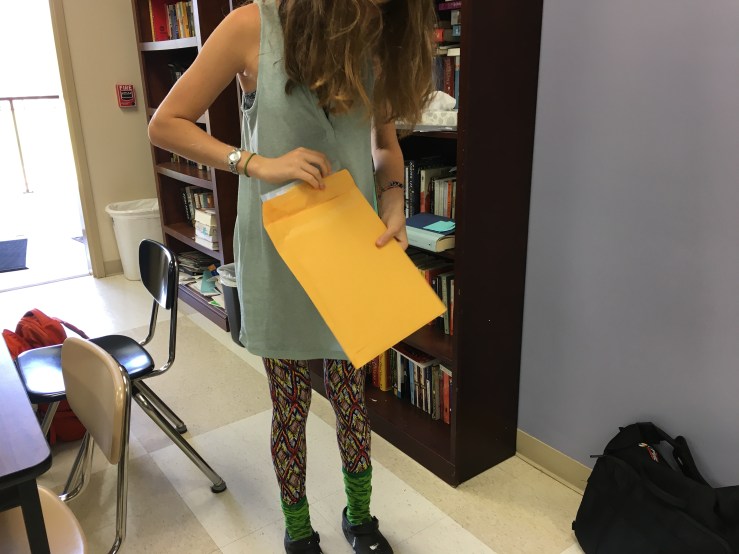
As Ellie opened the envelope, the rest of us waited a bit impatiently. There had already been some grumbling about “another nonfiction piece” as this particular group of students had taken AP Language last year and spent their days in that course swimming in the deep end of nonfiction. I reassured them. Knowing Tricia as I do, I was fully confident that the text she had selected would be surprisingly fun to play with and to analyze—I was confident that it would not only pique their curiosity but intrigue their intellect and mine.

When Ellie retrieved the set of copies from the folder inside the envelope, it quickly became apparent that the text was very short. A lone paragraph. Four sentences, to be precise

(The text happened to be the first paragraph from the article “The Arc of Justice and the Long Run” by Rebecca Solnit).

IMG_2509

Papers were distributed and we set to work…each of us, teacher and students, at the same time, in the same space…reading, thinking, writing, rereading, and so on. It was fun and all were engaged, and I’m also pretty sure there was some curiosity over what my ability was to work on something like this in front of them without a ton of time or extra resources…to encounter a text I hadn’t selected and to work with it in the same exact way that I ask them to do on a regular basis.

As we ventured into discussion, it didn’t take me long to realize that my kids absolutely loved not just the piece but the whole process. It was cool to feel a part of something bigger than themselves and their school. It was cool that another teacher had sent them a text that their own teacher had never seen before. And the piece itself captured them and inspired gorgeous conversation.

Students posed questions to each other; they wondered about the images/examples provided in the piece and spent a long time talking about the shape of an arc (they were shocked at how many math connections they made during their reading and our discussion—there was talk of getting too far down the wrong path beause of wrong window settings on calculators and the lack of slope at the top of an arc, and more); they talked deeply about the justice and hope brought up in the piece (and today of all days, that was a really great discussion to be having); students noted the progressively increasing sentence lengths throughout the piece and pondered why Solnit might have opted to do this, only to settle on a thematic connection; and at the end of the discussion, one of my students said, “I love this! It’s like a poem, but not a poem…which is my favorite kind of poem…I don’t have to think so much about the form of it.” They loved that Solnit left many of the ideas in the piece disconnected without forcing it on them –they appreciated her trust in them as readers to make the connections themselves.

Each of us enjoyed the camaraderie and surprise of it all and not a single one of us can wait patiently for what next month will bring.

It was a single class. On a day with a shortened schedule—45 minutes of time. It was a break from the literature we had been reading. A day away from the schedule we had been keeping as we push forward in a literary study. A day that was entirely off topic and entirely worth every second spent together in this new space. And I am left wondering how I can build even deeper continuing connections between this text and what we are currently working on together.

This is what happens when teachers are able to escape the confines of their classrooms and their schools in order to meet other teachers, other thinkers who work in other places. This is what happens when as teachers, we don’t just seek a clever pin-able idea, but instead we seek a community of learning…and then we act on the inspiration found there with confidence granted by the fellowship. This is what happens when we take on an idea having no idea how it will go, but we venture into this territory because we have the comfort of colleagues, even one who is 1200 miles away, and because we trust in our students. This is what happens when we step away from our plans and what feels comfortable and submit to the anxious excitement of trying something completely new—to the anxious excitement of learning beside our students.


Weights and Balances

Can I hear today? Am I dizzy or is the room cooperating and staying in one place?

These are the first two questions I ask every single solitary day that I have woken up for the last 5 years—since the moment my inner ear decided to stop communicating effectively with my brain…since the moment vertigo and hearing loss infiltrated my life stealing a bit of balance, a bit more of my hearing and freedom, and all of my confidence in my body. It’s a bit of an invisible illness– frustrating to both me and my family, as all of us struggle to understand and to find inroads to health and regular life…only to find that “regular life” doesn’t look the way it used to.

It’s the hearing loss that bothers me most. At it’s worst, the sound of my children’s voices is muffled and my husband finds himself speaking louder and more repetitively than he might care to (bless him for his patience!) and I find myself having to read lips. I fear total hearing loss in my left ear every moment of every day. The thought of the sounds of this world and the words my family speak to me being muffled or stifled completely, the thought of my own clarity becoming more muffled terrifies me.

So, it’s no wonder that when the Radiolab podcast on Words aired on my local NPR station today, I found myself sobbing in my car in a Starbuck’s parking lot. As the storyteller, a sign language interpreter, herself hearing impaired, revealed the story of her interaction with a 27 year old man born without hearing who not only was without words of any kind—no way to name himself or the things of the world, let alone his feelings—but who also had no idea they existed, I found myself deeply in awe of words and their meaning in our lives. When she spoke of the emotional moment he finally discovered words, I was overcome.

No matter what happens to me, to my hearing, at least I will have words.

Words fascinate me. Just ask any tenth grader who has passed through my classroom in recent years. The class is crafted to be a study in the importance of story in our lives and we begin our workshop with an investigation into words—their weight and power, how to balance them, how they play together to create rhythm and resonance. My students look at me like I’ve lost my mind when we begin this as if to say, “Uh, Mrs. Clark, we know words…we learned them a long time ago.”

I always have to explain that this is no simple exercise in vocabulary. If my students are truly seeking to express themselves meaningfully, with clarity and voice and style, they can’t just “know words.” They have to be able to place them on the page in a way that means something, that creates movement and moments, and the only way to really understand that is to be immersed in language.

So, how do we do that? Lots of way, really. My students are always reading independently—books of their choosing that excite them, that make them want to keep reading, that feel like a guilty pleasure and not homework. This isn’t always easy. But the struggle of pairing every kid with a book they want to read is worth it every single time.

I also begin the year with a central novel that we will consider as a class (this is one of maybe two or three whole class texts for the year). Sure, we study short pieces all year, but the crux of their reading is independently driven work. However, I start this way with a purpose. I select a text that will allow me to, as Ellin Keene would note, teach the reader/writer and not the book. Sure the story has to be compelling, but there must be a larger purpose. This year we are working with All the Light We Cannot See by Anthony Doerr. While I absolutely adore the story contained between the covers of this book and while it works to support our theme of “story”, I am teaching it because Doerr writes in a way that allows for intentional study of word choice and its power. We are 16 pages in and already students have noted the beauty of his craft and specifically how his choice of verbs acts to create suspense. And they have taken these observations to their writer’s notebooks for practice in their own writing.

Finally, though, it is important to note that the early days of our notebook work often center around poetry as well. This work is integral as poetry is more than just a great example of word economy, of a time when a writer (poet) had to choose only the best most precise words. It is more than the simple fact that poetry can include intense emotion or illustrative imagery.

Poets have the unique sensibility to play with rhythm, repetition and sound as well as placement on the page. Exposing students to and immersing them in the artistry of this craft uncovers newfound appreciation for the working of words and invites them to play a bit on their own—to venture out onto uncertain limbs to see what they can create and their writer’s notebook is the perfect place for this practice.

So, for example, we can look at a classic like Wordsworth’s “I Wandered Lonely as a Cloud” which always comes off as kind of simple and “beneath them” at first. Trust me, there are always a lot of 15 year olds with opinions about the quality of this particular poem and none of them are terribly forgiving…until we begin to discuss his word craft. After allowing them to respond to the poem in their notebooks in any way they wish (reflection, connection, illustration, etc), I ask them to go back and look for words that stand out to them and to explain why. When they have finished hunting and reflecting, we come together for some discussion. Inevitably, the conversation grows from merely a look at what it must mean to “wander” and to do so “lonely as a cloud”—my kids are always struck by the magnitude of the disconnect he must have felt—to a deeper reflection on the difference between loneliness and solitude (for in the end, he feels “…the bliss of solitude; /And then my heart with pleasure fills”). But there’s also the recognition of choosing a word like “golden” instead of yellow or the myriad words he uses to reveal the happiness of the daffodils who were “Tossing their heads in sprightly dance”.

It’s a good beginning and they start to see why we are studying words. So, we move on to other more complex examples… A.E. Stallings’ poem “Sestina: Like” is a beautiful and current poem, perfect for word study as well as for a look at the way we can use punctuation to deepen the meaning of our words and to either create or disrupt their rhythm. I also really love to have my tenth grade students study the first stanza of Eliot’s “The Lovesong of J. Alfred Prufrock” as the imagery is stark and the whole “like a patient etherized upon a table” image always brings us to an immense discussion of how crafting comparisons can change everything in a poem…can you imagine this poem without this image? It’s the beginning of Modernism. Had he phrased it even slightly differently, maybe “like a patient asleep on the table,” its weight, its impact would have been diminished and that is an important realization for kids—all it takes is a single word and everything can change. So we take this to our own writing and begin questioning the precision of our words and playing with how we place them on the page—in any writing form (poetry or otherwise).

As the weeks go on, I am also always sure to ask students to bring in poems they find that work in this way and I further this study by bringing in the work of poets like Lucille Clifton, Naomi Shihab Nye, Joy Harjo, Terrance Hayes, Gwendolyn Brooks, Mark Strand, and Rita Dove. These conversations, this work takes 10-12 minutes of class time a day before me move into our work for the day, but I would not give up that time for anything. It is some of the most important work we do and it inspires my students as readers, writers and thinkers not just in a classroom but also in the world.

All of this focus on words in my classroom has really sort of coincided with my inner ear (balance and hearing) adversity, and it brings me to wonder…is the recognition of the beauty of words working together, of the sounds they make in the silence of our minds, and how they are used to create something powerful, something important, something meaningful, really just a result my struggle to take them all in quickly, to appreciate the way they work together and to pass that along just in case one day it’s not so easy to do anymore? Or is it just where I would’ve landed professionally anyway, knowing that my young writers need this kind of study?

Hard to say really.

But in this time of volatile language, hostile tweets, inane memes and truly uncivil discourse, I can think of no more important study for my students than to dig in and truly learn to use words meaningfully, carefully and precisely… and to hopefully gain style and voice. Maybe in this way, they can begin to set the example for the rest of us!

No more apologies

We have to stop apologizing for poetry.

It’s tempting to do. I get it. So often when I ask students about poetry, they reply (loudly) in disgust proclaiming how much they hate it: Poetry is for kids and old romantic people, it’s too hard to understand, it doesn’t make any sense, and the list goes on.

And so, when we go to share a poem, we feel compelled to apologize for it in a way that we don’t apologize for novels we share or movies we love.

Yet, what I have come to discover is that as teachers, we might have the wrong idea about what it means to “teach” poetry.

I think so many of us see poetry only as a means to teach figurative language and analytical skills to students, as a means for students to make gifts and booklets, and as a means for students to read the poems that we love or that we were taught, that we unwittingly strip the poetry of its worth and meaning. In “schoolifying” poetry, and in only presenting it in this way, we deprive our kids of the opportunity to find themselves in the poems. We deprive them of the opportunity to linger in “the mist” that “becomes central to [their] existence” as Juan Felipe Herrera mentions in his poem “Let Me Tell You What A Poem Brings”. And we discount a genre that in its brevity and intentionality is perhaps one of the best writing teachers out there.

All of this gives me pause to wonder.

Why do we spend so much time talking about the importance of choice in a kid’s reading life if we are going to mandate the poems that they have access to? If, as the teacher in the room, we are the only ones with control over what poetry gets read, how can we ensure that our kids will be able to find themselves in the text? Are we really helping them create a robust, well-rounded reading life or just one that includes books?

I realized a couple of years ago, that my tenth grade students were hating every poem I brought to the classroom. After some research and help from colleagues, I realized that my students weren’t really resisting the form, they were resisting my need to control their interaction with it. So, I set them free…with some parameters…to seek the poems that meant something to them, to write those poems into a “poetry notebook”, and to, from time to time, share their selections with the rest of the class. I never anticipated what happened next.

Students took ownership and became engaged. They found poems the resonated with them and poets that they loved. They found word choice, imagery, language patterns and punctuation placement that deepened meaning–even when they weren’t required to analyze. Their notebooks became a precious space and reflected their individuality as the contents of this notebook were entirely up to them. They selected the poems and chose how they would respond to them; they wrote their own poems in their own voice after uncovering their own inspiration rather than one that was assigned; they made lists of poets they were excited to seek out; some even translated poetry into and from other languages. Each notebook was as different as each kid in the room and it was amazing. (For real, kids were coming to school exhausted because they were up late working in their notebooks and because they were annotating on https://genius.com )

When those students became seniors, they returned to my class. As I watched them work in their writer’s notebooks, I was left in awe. No particular genre was required in these entries, yet so often many of them freely opted to write in poetry. It had become part of who they were as writers. These same kids also populated my poetry elective course that year because they just wanted more time with the genre before they graduated. And I can’t lie. I was glad to have them. I learned more from these kids than I am pretty sure they ever learned from me. And because of my students, and their sharing of poems, I discovered poets I might never have met—poets like Jennifer Grotz (“Poppies”) and Amit Majmudar as well as Jude Nutter whose poem “The Insect Collector’s Demise” is now one that I return to frequently.

I also owe to them credit for some beginning of the year moments from this school year. They have all graduated and gone off to college and other endeavors but their legacy lives on through the opportunities my current students are now granted.

Part of my summer reading requirement is for my students to seek out at least 5 poems they are unfamiliar with and that they absolutely love. I offer them websites like https://www.poetryfoundation.org, https://www.poets.org, http://www.poetryoutloud.org and many more to use while finding these poems. Many poetry websites and apps will even send the kids a poem a day-which is a nice reminder, especially over the summer! They do not have to do anything with the poems except be willing to share one with the class upon our return in August. When the school year begins, and it is time to share poems, we do not all share on the same day. Rather, three students a day will share until everyone has gone, and we can continue the rotation after that as long as they are enjoying and finding meaning in it. In this way, the kids can really take in a few poems each class and pay attention to each classmate and the poem they selected to present. Finally, after the student reads the poem aloud, they explain why they chose it and then the rest of the class has the opportunity to discuss it as well.

This year, my students have taken full advantage of this opportunity. Their response has simply been phenomenal—kids sought out funny poems, political poems, poems that reminded them of places they have been… kids who have never liked poetry before were begging to share the poems they found.

And then there was this: Today, a student came to me and said that she was starting poetry sessions with her parents because they weren’t sure they even liked poetry and couldn’t remember reading any since college. She mandated that they seek out poems that they like and bring them to dinner the next night. So, tonight at their house, there will be a fantasy football draft, nachos, and poetry. (melt my whole heart!)

Poetry deserves our attention and not our apologies for its inclusion in our classroom. When given the right opportunities to linger with poems they have chosen, students begin to better understand not only themselves and the world at large, but the moves writers make and they begin to work with an intentionality that heightens the quality of their writing in all forms. They find themselves understanding that a dash can be a breath on the page and that dashes are different from parentheses (and they didn’t need a worksheet to tell them this—they just needed a poet applying punctuation meaningfully).

I’m going to close with the words of one of my students who wrote a letter to me before leaving for college: “Sophomore year, I had no real appreciation for reading and writing. Yeah, I would read a book or write an essay…however, there was no critical thinking which meant nothing there really connected me with it. If I went back and told my sophomore or freshman self that I now had a love for both reading and writing poetry, I would’ve laughed in my face. [Poetry has] opened up a completely new world for me and it’s a nice world to escape to every now and then.”

Every kid deserves this chance. Every kid deserves to find him/herself in a poem. All it takes is handing them the choice and trusting in them. They will do the rest themselves.

Shelter

Water is a deceptive friend. Necessary for survival while also unforgivably, forcibly, greedy for the life it fosters and all the items that celebrate the importance of it.

As I sit in my classroom, I can hear the sheets of rain pouring down, training in. It’s been doing this for a couple of hours now as the first bands of now Tropical Storm Harvey creep this direction–making it hard to concentrate. There’s a lot of uncertainty and a lot of friends so close by that are suffering an even greater deluge and significant loss.

As a native New Orleanian, I am no stranger to tropical weather systems and the destruction and pain they can leave in their wake. It is not a way of life by any means, rather a fact of it. Kind of like heat, humidity, good food and good conversation. We live here because it is home and because there is a culture here that ties us to this place and to each other and because epic weather events, increasingly, happen anywhere—not just here.

My parents lost their home and its contents to Hurricane Katrina when a levee broke blocks away, leaving their house to marinate in 8 feet of flood waters for weeks before finally receding. Flood waters are merciless and powerful, moving furniture unmovable by a single individual so that when people return home, the inside isn’t so recognizable, a kind of symbol for how life now feels. Rooms rearranged just as lives have become, making the safe harbor of home treacherous ground.

There are no words to place here that properly speak of the profundity of the devastation that comes with this kind of flooding. Sure, that house was just full of things that can mostly be replaced, but within and beyond that, there is so much that can never be returned or recovered. There are years of life stolen from an entire coastline of people as they figured out what to do next, how to recover. Of course we were grateful for each other and life and safety but reality can be a cruel visitor and overstayed his welcome that year.

The memories are visceral—the smell, the creeping mold, the ashen residue on trees, bushes, houses, the silence of a city shut down except for the whirring of helicopters circling. As I watch the footage of Houston, just as when I saw the Baton Rouge area flooding last year, my heart becomes increasingly and unbearably heavy in helplessness as I grieve for those in the midst of the crisis and grieve all over again for the loss suffered by so many in Katrina. I will work to send aid and to help in any way that I can, but the hardest work of the recovery process is the heartwork. There is no salve for that. It just takes time.

And in this heartache, I think of my own children and the young adults that I teach and the debt I owe them because when it comes down to it, I don’t teach English, I teach human beings.

This has been a very difficult start to the school year. My students returned with eyes opened wide to the hatred spewed in Charlottesville and now find themselves worried about their friends and family in Houston and if in fact we will flood at some point here as well.

They need a safe space. They need a space that shelters them from the storm a bit while they work on building the strength and the courage to help this world and its people. They need a space to ask questions and voice opinions and explore just what it is they feel and how to put it into words. They need their writer’s notebooks.

The writer’s notebook forms the core of my classroom and shapes my students as readers, writers, and thinkers in this world. In our classroom, the notebook is very clearly defined as a place to play with words and ideas—a place to find what is important in our lives and to put a voice to it. It is a place to venture into uncharted territory as a writer without fear of failure or a deduction of points. It is theirs, becoming a place that steers young writers toward the writing that will mean something to them—writing that will engage them—that they will compose because it feels important and not because of the points the piece might earn.

Yes, students receive points for this work. I ask them to pick five selections every nine weeks for me to read. However, I use this time with their work as an opportunity to lift up what they are doing so well and to encourage them along the way. A small note of “I know you say you aren’t a writer, but the ideas you express in this entry would suggest otherwise—they are so important and deserve expression and attention” can offer a boost of confidence to a writer that is changing. When the work isn’t graded in the same way we often have to grade so much of what they turn in, there is freedom for me to seek the good and to illuminate it.

The first responses in these notebooks are often prompted by poetry that I have shared with them. Poetry is rich in content, compact, varied in topic and style, and it is replete with carefully selected and organized words and punctuation chosen to create and deepen meaning. Each poem extends ideas that resonate deeming themselves worthy of consideration as well as a lesson to a writer. I ask students to simply respond in any way they are so moved. Some will draw. Others will analyze the work. Still others will offer opinions or begin a creative piece or something else entirely. And then we have time to share and discuss for anyone willing or moved to do so. In these first few days of school, as we have begun to create this safe notebook space, my students have responded to “Choose” by Carl Sandburg, “Jerusalem” by Naomi Shihab Nye, and “The Story, Around the Corner” also by Naomi Shihab Nye.

Their responses have astounded me, as they do every year. I really shouldn’t be surprised anymore, but every time my students and I begin to venture into this space I find myself awestruck as students volunteer to share some of what they have written with the class. Students of every level are working with challenging texts, and giving the freedom to do so in a way that means something to them, yields some pretty jaw dropping results. They have been bold and honest and revealed so much of how this world has shaped them as thinkers and as people. I think they have even surprised themselves.

Tomorrow, though, I will simply write the word “water” on the board and ask them to write. Some might write about how they hate drinking water because it is flavorless, others might write about how they love to swim or about how tired they are of the incessant rain, but there will also be those who will use this space to explore the deluge and flooding occurring so nearby and affecting loved ones and maybe even a vague Katrina memory still whispers inside and needs to be expressed. They will have safe space to do this work and listening ears all around if it will help them to share.

This is the least I can do. There will be more, but we begin in the safety of our notebooks.

(and this Natasha Tretheway poem keeps rising in my head. It is a part of a post-Katrina tribute to the Mississippi Gulf Coast…“Believer”)

Taking a Breath

The longer I live, the more it becomes apparent that my greatest responsibility is to love my neighbor. The longer I live, the more I see and feel the importance of working to remind my heart to see beyond a single action or word or belief; to understand that it comes from a place that I haven’t experienced; to see, respect and love the humanity that resides there (even when it is not always easily visible).

This is of course much easier to accomplish when I’m comfortable—at school, or around the people I know and have a reason to try to love, or with people who make it easy to love them. But as my friend and pastor, Chris Fryou, often points out, loving your neighbor most certainly also includes loving those that feel most difficult to love (the definition of those that feel difficult to love changes, I think, by the person as we all have our own safe spaces, comfort zones, and belief systems).

Today, I am uncomfortable. Today, I feel sick. Today, loving those individuals who feel and express the depths of their hatred for other human beings both vehemently and violently is my challenge and I’m failing miserably at seeing past what hurts so much.

Please do not mistake my words here. I take no issue with peaceful public displays of opinion and disagreement—with the lawful exercising of first amendment rights—even and especially of those that I don’t see eye to eye with. This kind of civil disobedience and the freedom to take part in it are a vibrant and important thread in the fabric of this nation. I believe that when we pull that thread, or even threaten to, the whole tapestry begins to unravel.

No, what I am struggling with is finding a way to extend a loving heart to a group of people who gathered together with the sole purpose of doing just the opposite…who gathered together with the insidious intent to intimidate those they hate, to incite fear, to illustrate boldly the vastness and totality of their hatred for entire groups of human beings on this planet as though the world has no means to support difference…who gathered knowingly to hurt other people (either in words or action or both).

How am I supposed to rise above the sickness and disdain that are simmering in my heart as I see these pictures and hear these stories? How, in my hurt and anger, do I stop hatred from rising in my own heart? How do I let love for others, even those I don’t know how to extend it towards, win me over and carry my actions just as much, if not more than they spur on my words? How do I accept that while I may not be able to ameliorate, to dissolve the hate in their hearts, I still must work to prove that hate is never an acceptable means of expression?

And then I think of the young people preparing to enter my classroom next week and the importance of the example I model for them…the importance of maintaining, as I’ve mentioned before, the ideal of “radical humanity” as a lens through which I plan my lessons (and live my life). And suddenly these questions reduce to one that is pretty simple—how do I not?

I talk to my students all of the time about digging deeper. I usually mean this in regard to some literary work or into whatever subject matter it is that they are writing about. It is a call to think beyond the superficial and to seek what isn’t so easily observed at first glance. A call not to be fooled by what appears simple and singular (by something like hatred) but to think further in search of truth, meaning and depth.

Increasingly these days, digging deeper takes on greater significance as something much more than representative of strong literary analysis. Despite offering a release from the burden and negativity of judgment, “digging deeper” becomes even more complicated when we are put in the position, as we are today, of witnessing to the truth of humanity rather than simply demonizing those who try to deny it—for in demeaning and diminishing we sink rather than rise…for in reciprocating their hatred, we reveal the worst of ourselves rather than the best and we become that which we are railing against.

Hatred always deems itself righteous, which is why it can be expressed so powerfully—it always feels justified. We cannot justify our hatred of those who hate. The emotion is the same no matter the reasoning behind it and it is the easier method of relief to reach for. Or, at least it seems to be. Until we have realized that our hearts are still sick and our hatred has resolved nothing.

We must seek love instead—even and especially when it is hard. We must allow it to catalyze our actions and reactions. It will be difficult at times. We will grow weary. But we will carry on knowing that the only way to heal hate is with love (and that begins in our own hearts).

I walk into my classroom this week not with a political agenda. I don’t need my students to think the way I do about the world or about politics. I don’t need them to agree with me. But we all have to live in this world together and as a teacher of students who will vote in the next election and who are our future decision makers, I feel it is imperative that they, at the very least, walk away from a year in my classroom understanding that hate is never an option. So we will have some difficult and courageous conversations…and we won’t always know how to feel about them…but we will always be working toward understanding, toward empathy, toward respecting others simply because they are human beings on this planet and we honor that.

Today though, on my own and in solitude, I am working on my heart. Today, I am seeking ways to love. Today, I will pray.

“Choose” by Carl Sandburg

“Jerusalem” by Naomi Shihab Nye